Ask an independent artist where their music makes money, and the answer is almost always "streaming." That's not wrong, but it's incomplete in a way that costs real money over time. A single released track generates several genuinely separate royalty streams, collected by different organizations, through different registration processes, and a distributor only ever touches one of them. The rest sit in accounts and collection pools, waiting for an artist who never signed up to come and claim them.
This isn't a hypothetical problem. It's large enough, and well-documented enough, that it's worth walking through carefully, one royalty stream at a time.
Why One Distributor Was Never Going to Cover Everything
It helps to start with what a distributor, Distrovibe included, actually does. When your music streams on Spotify, Apple Music, or any other DSP, your distributor collects and pays out the master recording royalty, the money tied to the specific sound recording, the actual audio file that got played. That's a real and often the largest single royalty stream for an actively streamed catalog, but it was never designed to be the only one.
A song carries two separate copyrights from the moment it's written and recorded: the composition, the underlying song, melody and lyrics, and the master, the specific recorded performance of that song. Each copyright generates its own royalties, collected by entirely different organizations, and registering for one doesn't automatically register you for the other. An artist who only ever interacts with their distributor is, by definition, only ever collecting the master side of what their music has earned.
The Mechanical Royalty Black Box: A Real, Documented Number
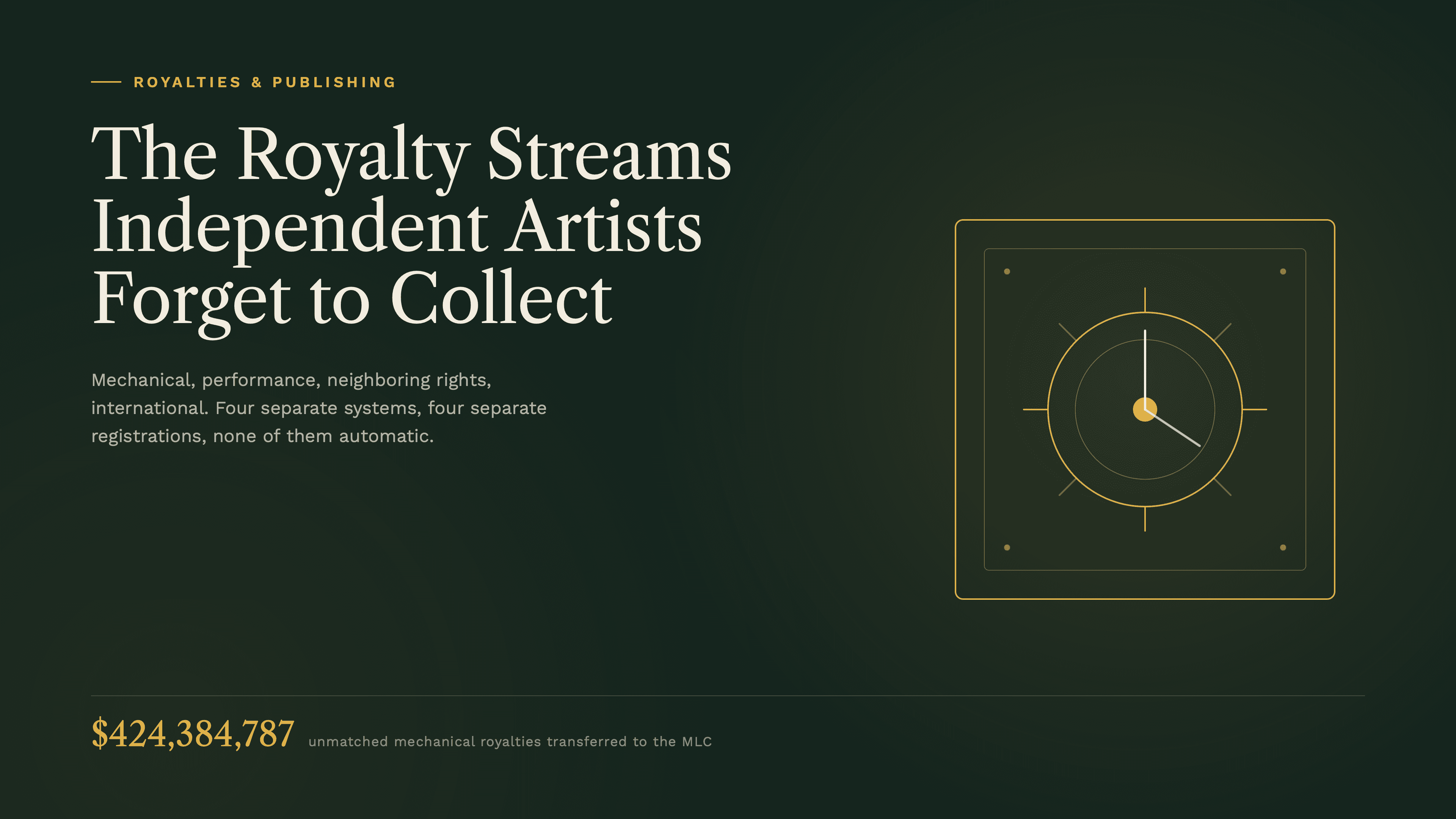
Here's a figure worth knowing because it's genuinely verifiable rather than a marketing statistic: when the 2018 Music Modernization Act created the Mechanical Licensing Collective, the MLC inherited $424,384,787 in accrued historical mechanical royalties from streaming services in 2021, money that had built up because streaming platforms couldn't identify who to pay it to. This is the largest one-time songwriter royalty transfer in U.S. history, and it happened because songwriters, particularly self-published, independent ones, hadn't registered anywhere the money could actually reach them.
Most of that specific pool has since been matched and distributed, but new unmatched mechanical royalties accrue every month from Spotify, Apple Music, Amazon, and YouTube plays inside the United States, and they sit unclaimed under the same mechanism until someone registers to collect them. If you wrote your own songs and haven't created a free Member account at themlc.com, this is very likely royalty income currently sitting somewhere you can't see it, generated by streams that have already happened.
Performance Royalties: The One Most Artists Half-Register For
Performance royalties, generated when your composition is performed publicly, streamed, played on radio, used in a venue, get collected by a Performing Rights Organization: ASCAP, BMI, or SESAC in the US, PRS in the UK, GEMA in Germany, and equivalent bodies elsewhere. A meaningful share of independent artists do register with a PRO, but often stop there, treating PRO registration as the finish line rather than the first of several steps. PRO registration covers performance royalties on the composition. It does not, on its own, collect mechanical royalties, which is why an artist can be a fully registered PRO member and still be missing the mechanical side entirely if they haven't separately registered with the MLC.
Neighboring Rights: The One Most Independent Artists Have Never Heard Of
This is arguably the biggest blind spot on this list, specifically because almost nothing in a standard distributor onboarding flow mentions it. Neighboring rights (sometimes called "digital performance royalties" for sound recordings) are generated when your master recording is played on non-interactive digital platforms, satellite radio, internet radio, cable music channels, or performed publicly outside the US. In the United States, these are collected by SoundExchange, a completely separate organization from your PRO and your distributor. Internationally, they're collected by neighboring rights societies specific to each country: PPL in the UK, SENA in the Netherlands, and similar bodies elsewhere.
If you own your masters, meaning you weren't signed to a label that owns them instead, you're entitled to register directly with SoundExchange as both the featured artist and the sound recording copyright owner, which are two separate registrations that pay out separately. Most independent artists never do either, which means royalties tied to satellite radio plays, internet radio spins, and international non-interactive digital use accumulate in a holding account indefinitely rather than reaching the artist who earned them.
International Royalties: Money Sitting in Another Country's System
If your music has been streamed, broadcast, or performed anywhere outside your home country, royalties were generated in that country's collection system, and without a registered connection there, that money has nowhere to go. This typically requires either registering directly with the relevant foreign society or working through a publishing administrator or sub-publisher who maintains those relationships on your behalf. PRS for Music in the UK, GEMA in Germany, SACEM in France, and JASRAC in Japan are among the larger examples, but the same structure repeats across dozens of countries. An artist with even a modest international audience, which describes most independent artists distributing globally through a standard distributor, likely has royalties sitting in at least one of these systems that a US-only registration never reaches.
YouTube: A Royalty Stream With Its Own Separate Mechanics
YouTube generates royalty income through several distinct channels: ad revenue from your own official channel, Content ID claims against videos that use your music without permission, and monetized user uploads that Content ID has correctly attributed to you. If Content ID isn't properly enabled on your catalog through your distributor, unauthorized use of your music on the platform can circulate without generating any royalty at all, not because the usage isn't happening, but because nothing is set up to recognize and monetize it when it does.
The Root Cause Behind Most of This: Metadata
A recurring theme across nearly every royalty stream on this list is that none of it gets collected correctly if your metadata, artist name spelling, songwriter credits, ISRC codes, is inconsistent or incomplete. Industry estimates on how much royalty income gets lost to metadata errors specifically vary fairly widely depending on the source and methodology, generally landing somewhere in a broad range from the high teens to as much as 20% of otherwise payable royalty income, which is a wide enough range that it's worth treating as directional rather than a precise figure. What's consistent across sources is the underlying mechanism: a mismatched ISRC, an inconsistent artist name across platforms, or an incomplete songwriter credit sends a royalty into an "unmatched" holding status rather than to the artist who earned it, and it stays there until someone corrects the record or claims it manually.
This is worth treating as a recurring maintenance task rather than a one-time setup step. Metadata errors can be introduced at any point, a typo on a later release, a collaborator credited inconsistently across platforms, and each one creates a new gap in an otherwise properly registered catalog.
A Practical Registration Checklist
Pulling this together into something actionable, here's the full set of registrations an independent artist who writes and owns their own masters should have in place, beyond a standard distributor relationship:
A Performing Rights Organization (ASCAP, BMI, or SESAC in the US; the equivalent in your country otherwise), for performance royalties on your compositions.
The Mechanical Licensing Collective, free registration at themlc.com, for US mechanical royalties on streams and downloads, including retroactive claims back to January 2021 for anything still unmatched.
SoundExchange, registered as both featured artist and sound recording copyright owner if you own your masters, for US non-interactive digital performance royalties.
A publishing administrator or sub-publisher relationship, for international mechanical and performance royalties in territories a US-only registration doesn't reach.
Content ID enabled through your distributor, so unauthorized use of your recordings on YouTube generates royalties rather than circulating unmonetized.
Consistent, accurate metadata across every release, checked as an ongoing habit rather than a one-time setup task, since a single inconsistency can misroute royalties on an otherwise fully registered catalog.
None of these registrations cost meaningful money, and most take well under an hour each. The barrier isn't cost or difficulty, it's that almost none of them happen automatically, and a standard distributor relationship was never built to cover them on its own.
The Bottom Line
A released song generates more income streams than most independent artists realize, and the gap between what a catalog has actually earned and what an artist has actually collected usually isn't a mystery, it's a list of registrations that were never completed. The mechanical royalty side alone accounted for a documented $424 million transfer when the MLC was created, and new unmatched royalties continue accruing in the same system every month. Performance royalties, neighboring rights, international collections, and Content ID each have their own separate gap, and each one closes with a registration that takes far less time than most artists assume.
Distrovibe handles the master royalty side of this with 100% retention and no commission on any plan, and includes Content ID as a standard part of every release so YouTube usage of your catalog gets properly attributed. The registrations above, PRO, MLC, SoundExchange, and international publishing, are steps worth taking directly and separately, since no single distributor relationship, Distrovibe included, was ever going to be the one place that covers all of it. You can see the full plan breakdown on our pricing page.