To start a music distribution company, you need seven working parts: store delivery in the DDEX format, rights and content checks, identity verification (KYC) of every artist, royalty accounting and payouts, an artist-facing platform, support, and a legal entity with artist agreements. You can build those parts in-house (typically a multi-person engineering team for a year or more), run them on a white-label platform (with DistroVibe, $750 one-time plus Label Pro at $149.99 per year), or start smaller as a label on an existing distributor.
This guide is for founders of labels, management companies, music schools, creator communities and music-tech apps who want to start their own music distributor and run it under their own brand. It explains how to become a music distributor in practice: what a music distribution business actually does behind the upload button, compares the three realistic routes on cost and time, and ends with a step-by-step launch plan. If you are still deciding whether you need a distributor at all or just a label, start with how to start a record label.
Key takeaways
Spotify tells artists to work with a distributor to get music on Spotify, and Apple encourages independent artists and smaller labels to use an Apple-preferred distributor, so a new music distribution company normally delivers through an established distributor's store agreements at first.
A music distributor is more than an upload form: it needs DDEX delivery, catalogue and rights checks, artist identity verification, royalty accounting, payouts, support and a legal entity with artist agreements.
Building a music distribution platform in-house means paying engineers for many months before the first release ships; at the US median software developer wage of $135,980 per year (BLS, May 2025), three developers cost about $407,940 a year in salary alone.
DistroVibe's white-label platform costs a one-time $750 setup fee, paid after a 48-hour trial, plus an active Label Pro subscription at $14.99 per month or $149.99 per year.
On DistroVibe's white-label platform, the partner keeps the artist relationship and the package revenue, while DistroVibe handles store delivery, catalogue checks and identity verification.
What does a music distribution company actually do?
A music distribution company takes finished releases from artists and labels, checks them, delivers them to streaming and download stores, collects the royalties those stores report, and pays the right people. Everything the artist sees, the upload form, the dashboard and the earnings page, sits on top of that pipeline.
Founders often underestimate the pipeline because the visible product looks simple. The work is in the parts the artist never sees. Here is each component a real music distribution business has to run.
1. Store delivery and DDEX
Stores receive releases as structured data, not as emails with attachments. The industry standard is DDEX, and its Electronic Release Notification (ERN) messages tell a digital service which releases are available, with the metadata for each track and the terms for when and where they may be offered (DDEX ERN). Anyone can implement DDEX with a free implementation licence, but a working delivery pipeline also needs store-specific profiles, file transfer, takedowns, updates and error handling for every store you support.
2. Store agreements
Writing DDEX is not the same as being allowed to deliver it. Stores sign agreements with the distributors they accept. Apple says it works directly with labels and distributors that have large catalogues and strong technical capabilities, and encourages independent artists and labels with smaller catalogues to use an Apple-preferred distributor (Apple iTunes Partner). Spotify's own guidance is simply to work with a distributor (Spotify for Artists). A new company usually starts by delivering through someone else's agreements.
3. Rights and content checks
Distributors are responsible for what they deliver. Spotify describes its recommended distributors as meeting standards for metadata quality and anti-infringement measures. In practice that means checking every release against commercial catalogues for copied or re-uploaded recordings, checking artwork and metadata, and having a human review unclear cases before delivery.
4. Identity verification (KYC)
Stores expect distributors to know who they are paying. A music distribution company needs an identity check for artists before their first delivery, secure storage for identity documents, and a way to see who is verified. This is also your first defence against fraud, artificial streaming and stolen catalogues.
5. Royalty accounting and payouts
Stores report earnings per track, per store, per country, per month, often months after the streams happened. Your accounting has to import those reports, match them to releases, apply your commission and each release's royalty splits, produce statements, and pay artists. Mistakes here cost trust faster than anything else.
6. The artist-facing platform
Artists need sign-up and sign-in, a release wizard that enforces audio and artwork specs, a catalogue view, analytics, earnings, splits and payout requests. Your team needs a back office to review releases, manage members, answer questions and run payouts.
7. Support, legal entity and agreements
You need a legal entity (a company or sole trader, depending on your country), artist terms of service, a privacy policy, a distribution agreement with whoever delivers your releases, and a support inbox that answers questions about delays, rejections and money. Talk to a local lawyer and accountant before you sign artists; this guide is not legal or tax advice.
Three ways to start your own music distributor
There are three realistic routes to start a music distribution business: build the whole stack in-house, launch your own brand on a white-label distribution platform, or start as a label on an existing distributor and grow from there.
Route 1: Build in-house
Building in-house gives you full control of the product and the data, and it is the right choice for a company that already has an engineering team, a large catalogue and the patience to negotiate store agreements. You build delivery, checks, KYC, accounting and both front ends yourself, then either negotiate direct store deals or plug into a distributor's delivery anyway. For a deeper breakdown, read build vs white-label music distribution platform.
Route 2: White-label
A white-label distribution platform gives you a finished artist portal and partner console under your brand, while the platform provider runs delivery and compliance in the background. You set the brand, packages and prices; your artists sign up with you. The trade-off is that you depend on the provider's stack and pay for it. What is white-label music distribution? explains the model in detail.
Route 3: Start as a label on an existing distributor
The lightest route is not to become a distributor yet: register a label account on an existing distributor, release your roster under your label name, and learn the business before investing in a platform. You do not get your own branded portal or your own packages for outside artists, but the cost and risk are small. See music distribution for record labels for how label accounts work.
How much does it cost to start a music distribution company?
The cost ranges from a label subscription on the low end, to under $1,000 in year one for DistroVibe's white-label platform, to hundreds of thousands of dollars for an in-house build. The table below shows year one for each route. In-house figures are illustrative and use the US median software developer wage from the US Bureau of Labor Statistics ($135,980 per year, May 2025); they exclude benefits, office, legal and store onboarding costs.
Route | What you pay in year one | Arithmetic | Source |
|---|---|---|---|
Build in-house, small team (illustrative) | $407,940 | 3 developers × $135,980 | BLS median wage, May 2025 |
Build in-house, lean team (illustrative) | $271,960 | 2 developers × $135,980 | BLS median wage, May 2025 |
DistroVibe white-label, yearly Label Pro | $899.99 | $750 setup + $149.99 Label Pro per year | DistroVibe white-label pricing |
DistroVibe white-label, monthly Label Pro | $929.88 | $750 setup + 12 × $14.99 | DistroVibe white-label pricing |
Label on an existing distributor | Varies by distributor | One label-tier subscription | Check the distributor's pricing page |
Salaries are only the visible part of an in-house build. You also pay for servers, storage for lossless audio, identity verification services, catalogue-matching tools, security reviews and the people who review releases and answer support. Those vary too much to quote, so treat the in-house rows as a floor, not an estimate. The full line-by-line breakdown is in how much a music distribution platform costs.
How long does each route take?
Time matters as much as money, because every month without a live platform is a month without paying artists.
Route | Time to first release (illustrative) | What decides it |
|---|---|---|
Build in-house | Many months to over a year | Team size, number of stores, store and distributor negotiations |
DistroVibe white-label | Days to a few weeks | Application review (usually within two business days), your DNS, email and package setup |
Label on an existing distributor | Days | Account sign-up and the distributor's release review |
The white-label timeline depends mostly on you: how fast you add a DNS record, connect a mail provider and a payment provider, and write your packages. No route can promise when stores publish a release, because each store runs its own review.
What you get with DistroVibe white-label
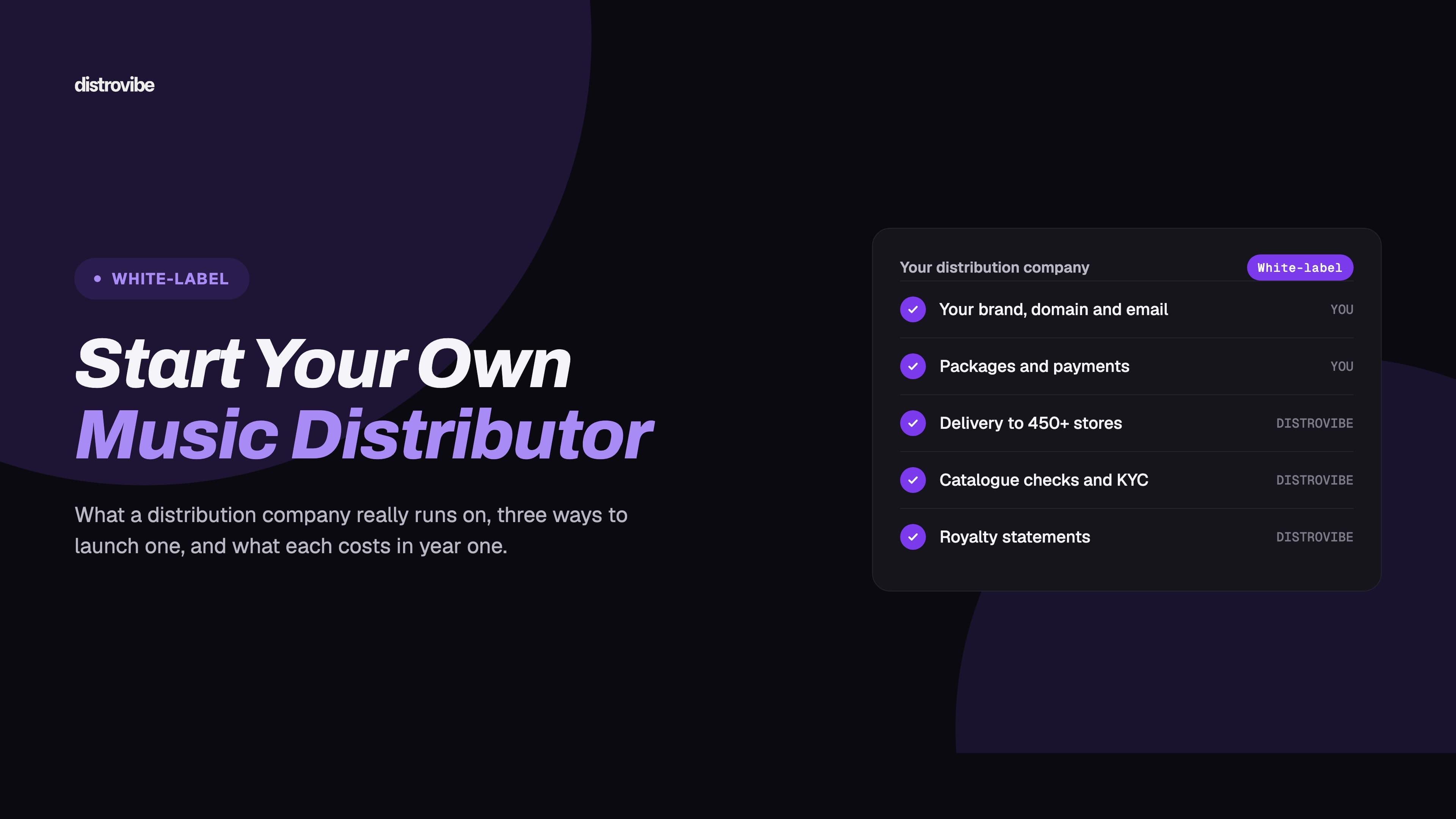
DistroVibe white-label gives you a branded artist portal and a partner console, while DistroVibe runs store delivery, catalogue checks and identity verification behind your brand. As of October 2026, it covers each component from the list above like this:
Component | Who handles it on DistroVibe white-label |
|---|---|
Store delivery | DistroVibe, to 450+ stores including Spotify, Apple Music, YouTube Music, TikTok, Deezer and Amazon, under your label name, through DistroVibe's store agreements |
Rights and content checks | DistroVibe checks every release against commercial catalogues before delivery; unclear results go to human review |
KYC | DistroVibe verifies every artist before their first delivery; you see each member's status in your console |
Royalty accounting | Store royalties for your catalogue are credited to your partner account; artists see their share after your package commission and their splits, with monthly statements and CSV export |
Artist payouts | Artists request payouts in your portal; you pay them and mark the request as paid |
Artist-facing platform | Your portal on your subdomain, with your logos, colours, 16 typefaces, sign-in screen and dashboard layouts; nothing on the portal mentions DistroVibe |
Pricing and payments | Your packages (free, monthly, yearly or one-time, in USD, EUR, GBP or TRY) paid into your own Stripe, PayPal, Paddle, Lemon Squeezy, Polar, Dodo Payments, iyzico, PayTR or Shopier account |
Support and legal | You: your support email, help centre, terms and privacy links appear in the portal footer; you sign a partner agreement with DistroVibe |
Two details matter for founders. First, DistroVibe never holds or passes through your package revenue: artists pay you directly through your payment provider. Second, the artist relationship is yours. DistroVibe contacts your artists only when stores or the law require it, for example for identity verification.
If that split of work fits your plan, you can apply for DistroVibe white-label in about five minutes.
What's the catch?
White-label is the fastest way to start a music distribution company, but it is not free of trade-offs, and you should know them before you apply.
You pay your artists. On DistroVibe white-label, store royalties land in your partner account and you handle artist payouts. That means you need a process and the cash discipline to pay on time.
Label Pro must stay active. The platform runs on an active Label Pro subscription ($14.99 per month or $149.99 per year) on top of the one-time $750 setup fee.
Identity checks are not optional. Every artist is verified before their first delivery, as stores require. Some artists will drop off at that step; that is the price of a clean catalogue.
The distributor is visible to experts. Your portal, emails and store listings show your brand, but DDEX records the delivering distributor in a release's technical metadata. This is the same for every label that releases through a distributor.
Subdomains only. The portal runs on a subdomain such as artists.yourbrand.com; a root domain can't hold the required CNAME record.
Your legal homework stays yours. You still need your own entity, artist terms, privacy policy and tax setup.
How to start a music distribution company with DistroVibe white-label
Launching on DistroVibe white-label takes six steps, and only the first one happens before you can see the product.
Set up your entity and terms. Decide whether you apply as a company, sole trader or individual, and prepare artist terms and a privacy policy. You will need a DistroVibe account to apply.
Apply at /white-label/apply. The form asks about your company, your artists, whether you deliver through DistroVibe's store agreements or have your own, any current distributor, the subdomain you want, where artists sign up and how they pay. It takes about five minutes, and DistroVibe usually replies by email within two business days.
Subscribe to Label Pro and explore for 48 hours. Once approved, the partner console opens right away. Use the trial to check that the portal, packages and payouts fit your model before paying the setup fee.
Brand and connect. Add your logos, colours, sign-in screen and dashboard layout; point one CNAME record at DistroVibe for your subdomain (TLS is issued and renewed automatically); connect your mail provider (presets for Google Workspace, Microsoft 365, Zoho, Amazon SES, SendGrid, Postmark, Resend and others, or any SMTP); connect your payment provider in test mode first.
Create your packages. Set prices, limits on artist profiles and releases per month, and the commission you keep from royalties (0 to 100%). If you already have an app with its own sign-in, set up single sign-on through JWKS so artists don't need a second password.
Sign, pay and invite. Sign the partner agreement online, pay the $750 setup fee, switch payments to live mode and invite your first artists.
FAQ
No. On DistroVibe white-label, partners can deliver through DistroVibe's store agreements. If you already have direct store agreements, you can say so in your application and DistroVibe will discuss how to work with them.
It depends on the route. DistroVibe white-label costs $899.99 in year one with yearly Label Pro ($750 setup plus $149.99), while an illustrative in-house build with three US developers costs about $407,940 a year in salary alone. A label account on an existing distributor costs one subscription.
Most charge artists a subscription or one-time fee, keep a commission on royalties, or both. On DistroVibe white-label you design those packages yourself, from free to paid, with a royalty commission between 0 and 100%, and package payments go straight to your own payment provider.
Yes. DistroVibe white-label accepts companies, sole traders and individuals running a label, a management company or a music platform. Check your local rules on registering a business before you take payments from artists.
Not from the portal or emails: nothing on the portal mentions DistroVibe, and emails go out from your domain. DDEX store deliveries record the delivering distributor in technical metadata, so someone looking closely can find it, as with any label using a distributor.
Yes, you can apply while working with another distributor. Name it in your application; depending on the distributor and what it supports, DistroVibe can look into moving your catalogue or integrating with it.
Start your distribution company this month, not next year
Starting a music distribution company no longer requires a year of engineering and store negotiations. With DistroVibe white-label, you launch your own branded portal for a one-time $750 plus Label Pro at $149.99 per year, keep your artists and your package revenue, and leave delivery, catalogue checks and identity verification to DistroVibe. Apply for DistroVibe white-label, or see every feature first on the white-label overview.