Free music distribution is free to start, not free to run. Free distributors make their money by keeping a share of your royalties (usually 15%), charging per-release fees or selling paid upgrades. On a 15% cut, you pay more than a $19.99/year flat plan once your music earns about $133 a year. At an illustrative $0.003–$0.005 per stream, that is somewhere between roughly 27,000 and 45,000 Spotify streams a year.
This guide explains how "free" distributors earn money and which free offers still exist as of October 2026. It then works through what a 15% commission really costs at 10,000, 50,000 and 250,000 streams. Every competitor figure links to that company's own page. Prices change often, so check the current terms before you sign up anywhere.
Key takeaways
As of October 2026, RouteNote is the best-known distributor with a permanent free tier. RouteNote Free charges no upfront fee and keeps 15% of streaming and download revenue, so the artist keeps 85%.
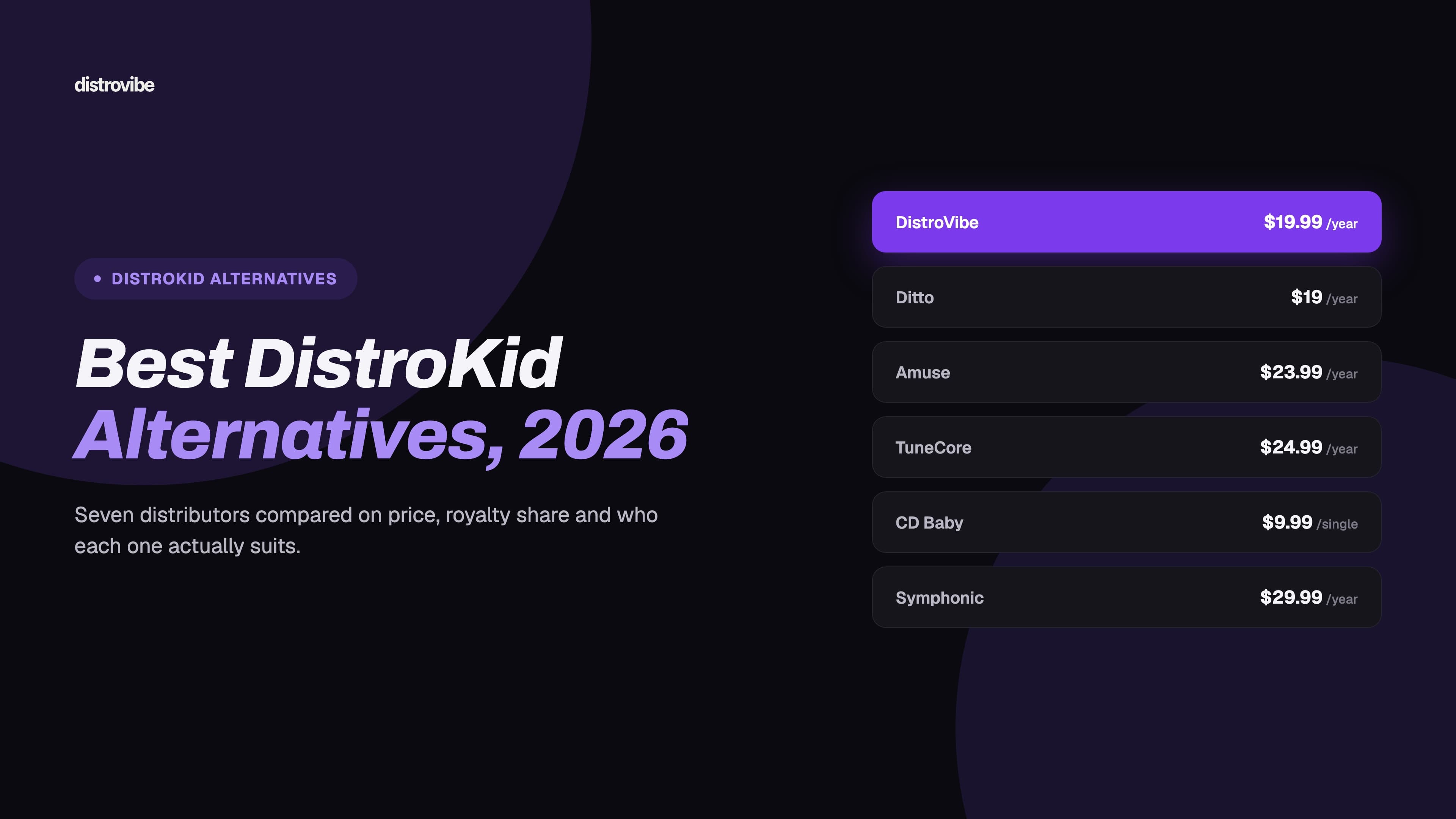
As of October 2026, Amuse no longer offers a free plan. Amuse's cheapest plan, Artist, costs $23.99 per year.
As of October 2026, Soundrop has no annual fee but charges $4.99 per track and keeps 15% of royalties.
A 15% royalty commission costs more than a $19.99/year flat-fee plan once a catalog earns about $133.27 in royalties per year ($19.99 ÷ 0.15).
DistroVibe's Artist plan costs $19.99 per year (or $1.99 per month), includes unlimited releases and lets the artist keep 100% of streaming royalties.
How do free music distributors make money?
Free music distributors make money from your music after it starts earning, instead of charging you up front. Delivering releases to Spotify, Apple Music and hundreds of other stores costs money: storage, delivery feeds, content moderation, support staff and royalty accounting. A distributor that charges nothing at sign-up has to recover those costs somewhere else. These are the five most common models.
1. A commission on your royalties
A royalty commission is the most common way a free distributor gets paid. The distributor collects the money that stores pay for your music and keeps a percentage before passing the rest to you. The industry norm for free tiers is around 15%. A commission costs nothing while your music earns nothing, and it keeps growing as your audience grows.
2. Per-release or per-track fees
Some distributors with no annual fee charge a one-time fee for each release or track instead. Soundrop, for example, lists $4.99 per track with no annual fees, and it also takes 15% of royalties (Soundrop pricing, checked October 2026). A per-track fee looks small, but a 12-track album costs $59.88 to release under that model before any commission.
3. Paid upgrades and add-ons
Free tiers are often the bottom of a ladder of paid upgrades. Common extras include keeping 100% of royalties, YouTube Content ID, pre-save pages, custom label names, priority support and faster release delivery. Upsells are not a problem in themselves. Just add them up before you compare a "free" service with a paid one.
4. Fewer stores or slower handling on some free tiers
Some free tiers deliver to fewer stores or give paying customers priority in review and support. This is not universal. RouteNote says its Free and Premium plans go to the same stores and pass through the same moderation process (RouteNote: Free or Premium, July 2026). Read the plan comparison of any distributor you are considering. Look for a store list and a review time for each tier.
5. Conditions on inactive accounts, cancellations and takedowns
The fine print on account inactivity, cancellation and takedowns is where "free" can get expensive later. Some services have suspended inactive free accounts, charged fees to remove releases, or raised their commission on music left online after a subscription ends. Before uploading, search the distributor's terms for "inactive", "takedown", "removal" and "cancel".
Which free music distributors are still free in October 2026?
Only a handful of established distributors still offer a genuinely free tier in October 2026. Several well-known free plans have ended since 2024. The table below covers three services artists often ask about, using each company's own pages.
Distributor | Free option (October 2026) | How it earns money | Source |
|---|---|---|---|
RouteNote Free | Yes, no upfront or annual fee | Keeps 15% of streaming and download revenue. RouteNote Premium (100% kept) costs $10 per single, $20 per EP, $30 per album or $45 per extended album, then $9.99 per release per year after year one. | |
Soundrop | Free account, but releases cost $4.99 per track | $4.99 per track plus 15% of royalties; no annual fee | |
Amuse | No. The free tier has been discontinued | Annual plans: Artist $23.99, Artist Plus $39.99, Professional $59.99 |
Each of these services is good at something. RouteNote Free is a fair choice for an artist testing the waters with music that may never earn much. Its option to switch individual releases between Free and Premium is flexible. Soundrop has long been popular for cover songs because the per-track fee includes cover licensing. Amuse moved to paid-only plans that look a lot like other flat-fee distributors. For a full head-to-head, see DistroVibe vs Amuse.
RouteNote free vs paid: which is cheaper?
RouteNote Free is cheaper for a release that earns very little. RouteNote Premium becomes cheaper once a single release earns more than its yearly fee divided by 15%. A Premium single renews at $9.99 per year after its first year, so the break-even is about $66.60 of royalties per year for that single ($9.99 ÷ 0.15). In the first year, the $10 single fee breaks even at the same level, about $66.67.
RouteNote's Premium fees are charged per release, so a larger catalog multiplies them. A flat-fee plan charges the same amount however many releases you have. That difference is what the next two tables are about.
The real cost: what a 15% free distributor royalty cut costs
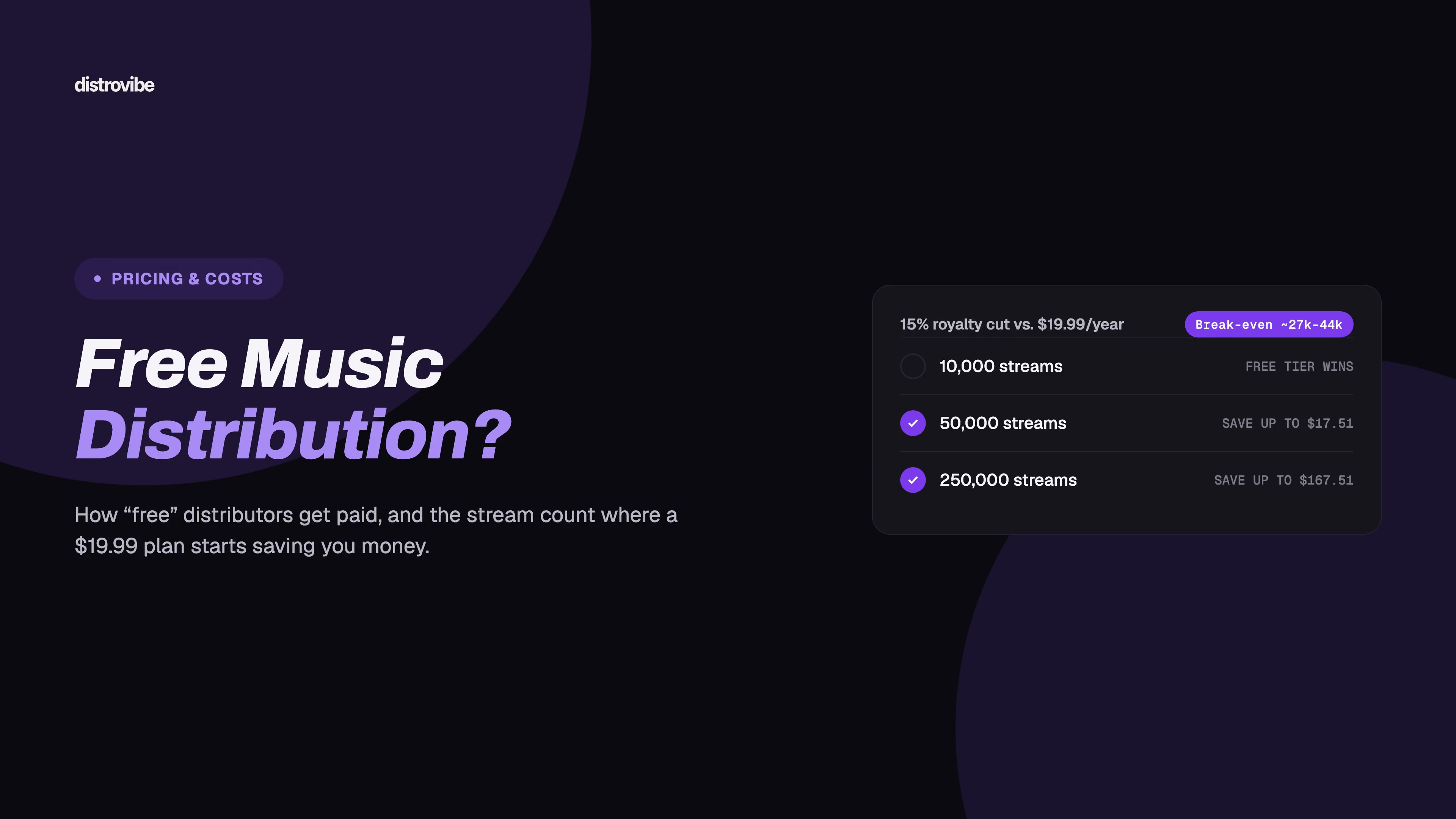
A 15% royalty cut costs $4.50 to $7.50 a year at 10,000 streams, $22.50 to $37.50 at 50,000 streams and $112.50 to $187.50 at 250,000 streams. Those figures use an illustrative rate of $0.003 to $0.005 per stream.
About the per-stream assumption. Spotify says it "does not pay artist royalties according to a per-play or per-stream rate" (Spotify for Artists: Royalties). Spotify pays rightsholders by streamshare, meaning their share of total monthly streams. Your effective earnings per stream depend on listener country, Premium vs free listeners and your distribution deal. The $0.003–$0.005 range is a widely reported industry estimate, for example in this May 2026 per-stream breakdown. Treat it as an illustration, not a promise. Also, since April 2024, Spotify only pays royalties on tracks that reach at least 1,000 streams in the previous 12 months.
Streams per year | Gross royalties ($0.003–$0.005) | 15% cut on a free distributor | You keep on a free distributor (85%) | You keep on a $19.99/yr plan (100% minus $19.99) | Cheaper option |
|---|---|---|---|---|---|
10,000 | $30.00–$50.00 | $4.50–$7.50 | $25.50–$42.50 | $10.01–$30.01 | Free distributor |
50,000 | $150.00–$250.00 | $22.50–$37.50 | $127.50–$212.50 | $130.01–$230.01 | $19.99/yr plan |
250,000 | $750.00–$1,250.00 | $112.50–$187.50 | $637.50–$1,062.50 | $730.01–$1,230.01 | $19.99/yr plan |
Here is the arithmetic for one row. At 50,000 streams and $0.003 per stream, gross royalties are 50,000 × $0.003 = $150.00. A 15% cut is $150.00 × 0.15 = $22.50, which leaves you $127.50. On a $19.99/year plan you keep the full $150.00 and pay $19.99, which leaves $130.01. The flat plan comes out ahead by $2.51, and at $0.005 per stream it comes out ahead by $17.51.
The break-even point is $19.99 ÷ 0.15 = $133.27 in royalties per year. At $0.005 per stream that is about 26,700 streams a year. At $0.003 per stream it is about 44,400 streams a year. Below that, a 15% free tier is genuinely cheaper. Above it, the commission costs more every year, and at 250,000 streams it costs $92 to $167 more than the flat plan. To run the numbers for your own streams, use our Spotify royalty calculator, and see how many streams it takes to make $1,000 on Spotify.
What does a small catalog cost over three years?
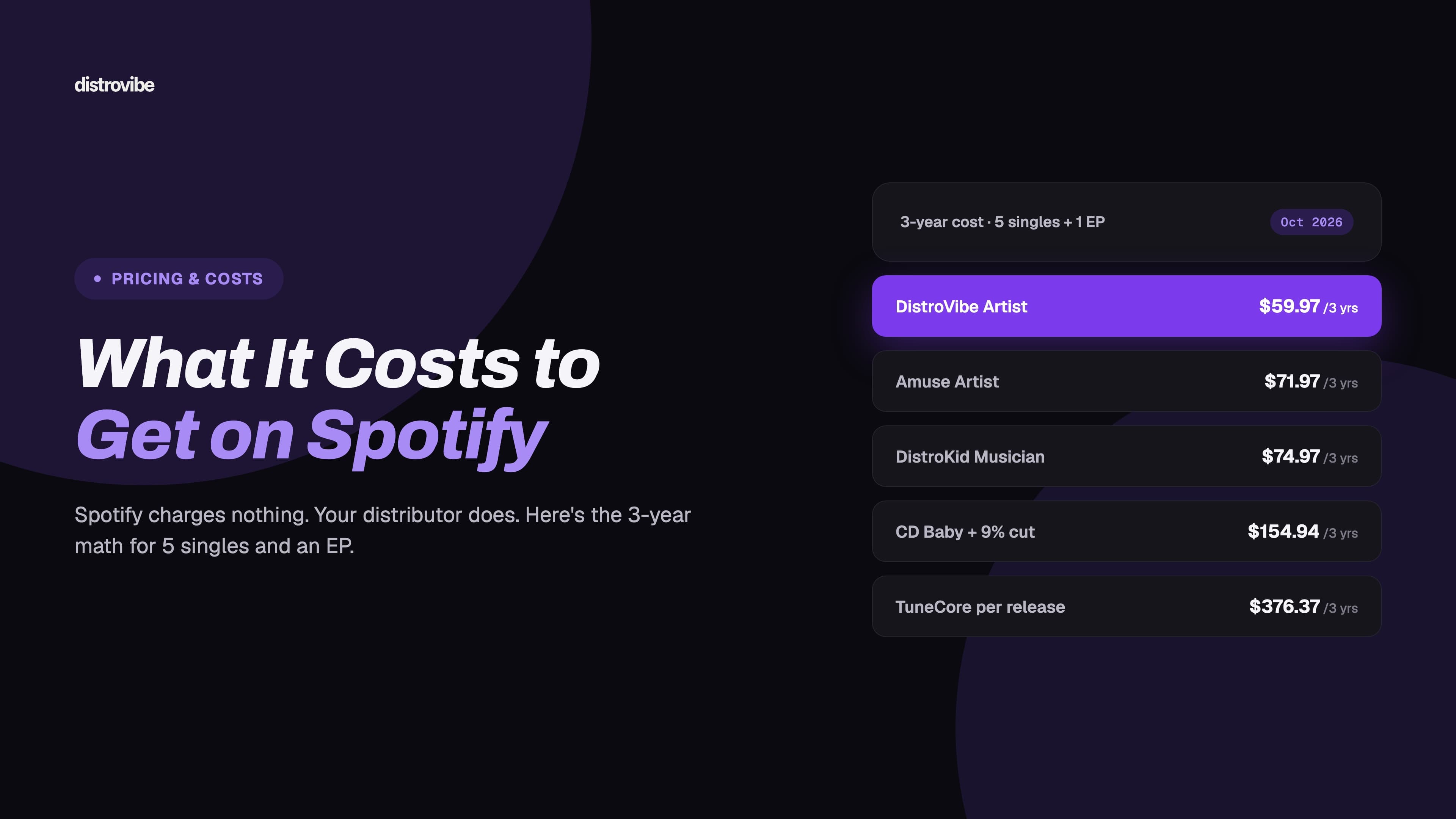
A small catalog of five singles and one four-track EP costs $59.97 over three years on a $19.99/year unlimited-release plan, before any royalty commission. The comparison below assumes all six releases (nine tracks) go out in year one and stay live for three years. It shows fees only. Commission-based costs are listed separately because they depend on your streams.
Service and model | Fee arithmetic over 3 years | Fees over 3 years | Royalty commission |
|---|---|---|---|
RouteNote Free | No fees | $0.00 | 15% of streaming and download revenue |
RouteNote Premium | (5 × $10 + 1 × $20) + 6 releases × $9.99 × 2 renewal years = $70.00 + $119.88 | $189.88 | 0% |
Soundrop | 9 tracks × $4.99 | $44.91 | 15% |
DistroVibe Artist (yearly) | 3 years × $19.99 | $59.97 | 0% on streaming royalties |
If that catalog earns $300 a year in total, a 15% commission costs $45 a year, or $135 over three years. Add that to the fees column and RouteNote Free costs $135.00, Soundrop costs $179.91, and DistroVibe's Artist plan stays at $59.97. The more your music earns, the wider that gap gets. For the full breakdown of upload costs, read how much it costs to put music on Spotify.
If your streams are already past the break-even point, DistroVibe's Artist plan at $19.99 a year lets you keep 100% of streaming royalties on unlimited releases.
Is it ever smart to distribute music for free?
Yes. Distributing music for free makes sense when you expect a release to earn less than about $133 a year, or when you only want to test the process. Good examples are a first demo, a hobby project or a one-off collaboration. In those cases a 15% cut of very little money is cheaper than any subscription.
Free distribution makes less sense when you are building a career. Releasing regularly, pitching to playlists or running ads all push your streams toward and past the break-even point. Moving distributors later is possible without losing your streams, as long as you keep the same ISRC and UPC codes (see switching to DistroVibe). Still, it is simpler to start on the model that will suit you a year from now.
Before choosing any free distributor, check these five things:
Commission rate: what percentage it keeps, and whether the rate is different for YouTube, social platforms or publishing.
Fees: any per-release, per-track or renewal fees, and what happens if you stop paying them.
Store list: whether the free tier reaches every store you care about.
Review time: how far in advance you must submit to hit your release date.
Exit terms: takedown fees, inactivity rules and how you get paid out when you leave.
What's the catch with DistroVibe?
DistroVibe is a flat-fee distributor, so the main trade-off is that you pay even in a year when your music earns little. Here are the honest answers to the questions artists ask most.
DistroVibe is not free. DistroVibe's Artist plan costs $19.99 a year or $1.99 a month. Automatic regional purchasing-parity discounts apply in many countries and are shown at checkout. If your music earns less than about $133 a year, a 15% free tier will cost you less.
DistroVibe is younger than TuneCore or CD Baby. DistroVibe has a shorter track record than the oldest distributors, though it serves more than 1,000 active catalogs as of October 2026.
YouTube Content ID needs Artist Pro. Content ID with 0% commission comes with DistroVibe's Artist Pro plan ($29.99/year) and above. It is not part of the base Artist plan.
Standard review takes 5–7 days on Artist. DistroVibe's Express Fast-Lane review (24–48 hours) is included on Artist Pro and above. On the Artist plan, schedule your release at least a week ahead.
How to get started on DistroVibe
Getting a release live on DistroVibe takes six steps, from creating an account to sharing a SmartLink.
Create your account at /register and choose a plan: Artist, Artist Pro, Label or Label Pro.
Verify your identity and accept the distribution agreement in the short onboarding flow.
Start a release and add the basics: title, artist name, genre and cover artwork.
Upload your audio and fill in track details, such as credits and ISRCs if you already have them.
Pick a release date and your stores from 450+ platforms, including Spotify, Apple Music, TikTok and Instagram. Standard review needs about a week of lead time.
Review, submit and share a SmartLink so fans can pre-save and find the release on every store.
FAQ
Free music distribution usually costs nothing up front, but the distributor keeps part of your royalties, typically about 15%. Some services also charge per-release or per-track fees or sell paid upgrades. You pay through your earnings instead of a subscription.
As of October 2026, RouteNote Free is the most established distributor with a permanent free tier. It keeps 15% of streaming and download revenue. It is a reasonable choice for low-earning releases. Check the current terms on RouteNote's site before you upload.
At an illustrative $0.003–$0.005 per stream, a 15% cut costs $4.50–$7.50 a year at 10,000 streams and $112.50–$187.50 a year at 250,000 streams. It overtakes a $19.99/year flat plan once your royalties pass about $133 a year.
No. As of October 2026, Amuse's pricing page lists only paid annual plans: Artist at $23.99, Artist Plus at $39.99 and Professional at $59.99.
Yes. You can move a release to another distributor and keep its streams and playlist placements if you reuse the same ISRC and UPC codes. Upload the release at the new distributor first, wait until it is live, then remove it from the old one.
A paid distributor is worth it once your yearly royalties pass the break-even point, which is about $133 a year against a 15% commission and a $19.99 plan. Some artists pay sooner because they want to keep 100% of their royalties from day one.
Ready to keep 100% of your streaming royalties? DistroVibe starts at $1.99 a month with unlimited releases to 450+ stores. Create your account or compare the plans.