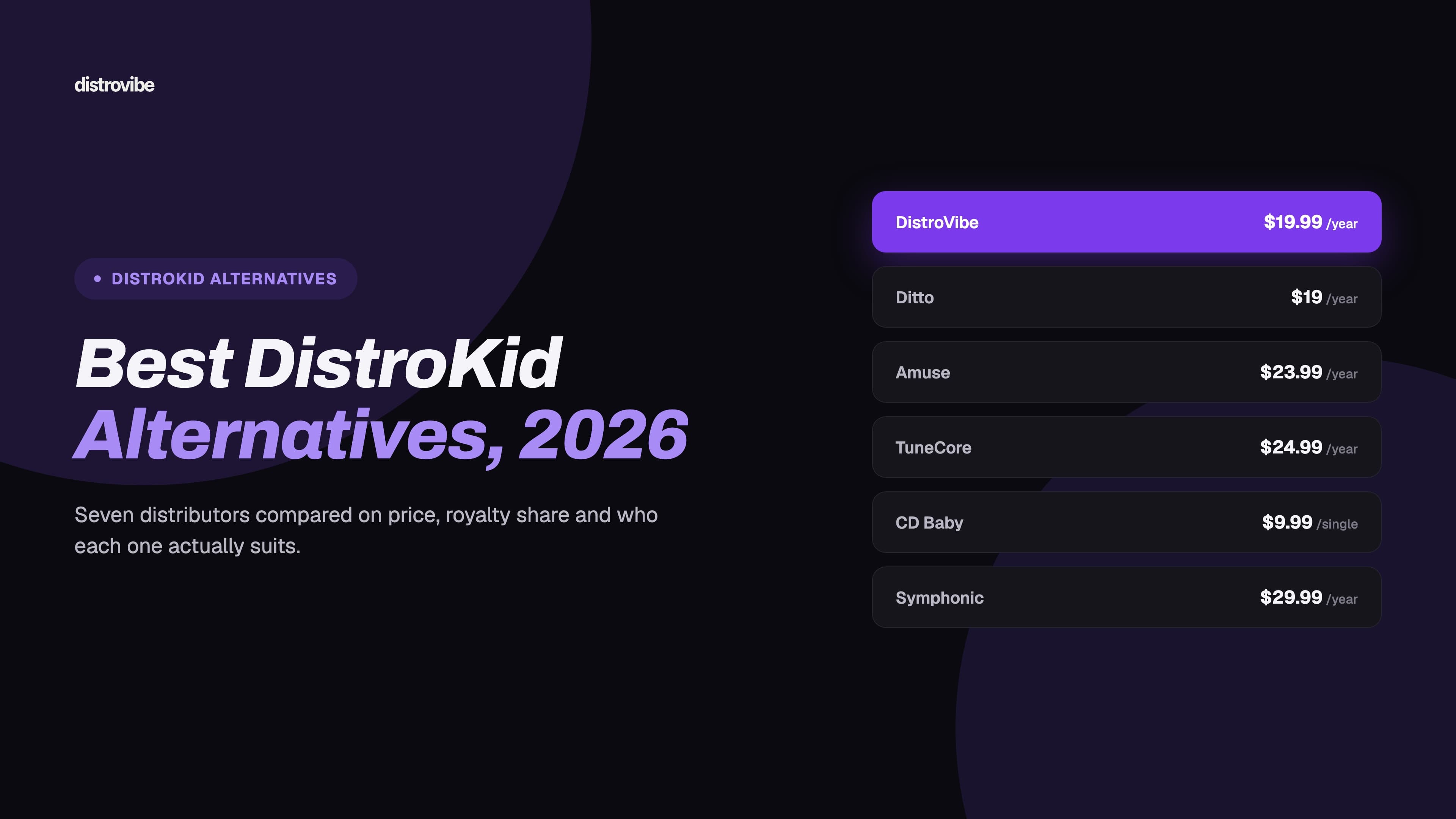
The best DistroKid alternatives in 2026 are DistroVibe, TuneCore, CD Baby, Amuse, Ditto, UnitedMasters and Symphonic. Each one fixes a different DistroKid pain point: lower yearly cost, pay-once releases, Content ID without a commission, or a route to label-style support. Below you will find who each service suits, how it charges and what share of royalties you keep. Every figure was checked on the company's own site in October 2026.
This guide is for artists who already use DistroKid and want to know whether switching is worth it. If you just want the lowest price on the market, read our cheapest music distribution platforms roundup instead.
Why artists look for sites like DistroKid
DistroKid is popular for good reasons. Uploads are unlimited, releases go out fast, and splits are built in. According to its pricing page, artists keep 100% of their earnings on every plan. Most people who leave aren't unhappy with the core service. They leave because the total cost grows as the catalog grows.
DistroKid's current pricing (October 2026)
Musician: $24.99/year for 1 artist.
Musician Plus: $44.99/year for 2 artists. Adds synced lyrics on Apple Music, daily stats, a custom label name, and custom release and pre-order dates.
Ultimate: $89.99/year for 1 to 100 artists. Adds advanced analytics, the option to replace song audio, and more.
The add-ons that change the math
Some features are not included in the yearly plan. DistroKid's support center lists these extras on its album extras page:
Leave a Legacy: a one-time fee of $29 per single or $49 per album. It keeps a release live if your subscription lapses. Without it, a release can come down when you stop paying.
Store Maximizer: $7.95 per release per year. It sends your music to new stores as DistroKid adds them.
YouTube Content ID / Social Media Pack: an optional yearly add-on, charged per release. On top of that fee, DistroKid keeps 20% of the ad revenue from videos it identifies.
Each fee is small on its own. But an artist with 30 singles who wants every release to stay live for good would pay $870 for Leave a Legacy alone. That is the moment most artists start comparing DistroKid alternatives.
Other common reasons to switch
You manage several artist profiles and the Ultimate plan feels expensive for what you use.
You want YouTube Content ID without a revenue cut.
You want to pay once per release instead of every year.
You want a team, a custom label imprint, or split accounting for a small roster.
Quick comparison: the best DistroKid alternatives in 2026
Distributor | Best for | Pricing model | Entry price (Oct 2026) | Royalty share |
|---|---|---|---|---|
DistroVibe | Budget-conscious artists and small labels | Subscription, monthly or yearly | $1.99/month or $19.99/year | 100% of streaming royalties; Content ID at 0% commission on Artist Pro and above |
TuneCore | Artists who want a long-established brand and publishing options | Yearly plans or pay per release | $24.99/year | No streaming percentage listed; 20% fee on TikTok, Meta and YouTube earnings |
CD Baby | Artists who hate recurring fees | One-time fee per release | $9.99 per single, $14.99 per album | 91% of digital distribution revenue (CD Baby keeps 9%) |
Amuse | Mobile-first artists who release often | Yearly subscription | $23.99/year | 100%; 15% Content ID fee on the base Artist tier |
Ditto | Lowest yearly price for a single artist | Yearly subscription | $19/year | 100% of streaming royalties; 15% on publishing and sync (Pro) |
UnitedMasters | Artists chasing brand and sync deals | Yearly subscription; Partner tier is invite-only | $19.99/year | 100% of streaming royalties on DEBUT+ and SELECT |
Symphonic | Artists who want to grow into a label-services deal | Yearly Starter plan or approved percentage deal | $29.99/year | 100% on most platforms; 70% on YouTube, TikTok, Instagram and Facebook (Starter) |
Prices are in USD. Most of these companies change prices from time to time, so check their current pricing page before you buy.
1. DistroVibe: best overall DistroKid alternative for value
Yes, this is our own product, so read this section with that in mind. We put it first because it targets the exact cost problem described above. Then we list where it falls short.
Best for: solo artists who want unlimited releases for less than DistroKid's entry plan, and small labels that need a roster tool without enterprise pricing.
Pricing model: a subscription you can pay monthly or yearly. Regional purchasing-parity discounts may apply.
Artist: $1.99/month or $19.99/year. 1 artist profile, unlimited releases, 450+ stores, and standard delivery review in 5–7 days.
Artist Pro: $2.99/month or $29.99/year. 3 artist profiles, Express Fast-Lane review in 24–48 hours, YouTube Content ID at 0% commission, and official VEVO channel and music video delivery.
Label: $5.99/month or $59.99/year. Unlimited artist profiles, a custom DDEX party name and imprint on stores, automated royalty and commission split accounting, bulk CSV catalog ingestion and migration, and a dedicated account manager.
Label Pro: $14.99/month or $149.99/year. Everything in Label, plus a developer API (still rolling out) and priority technical support.
Royalty share: you keep 100% of streaming royalties on every plan. Content ID is not on the base Artist plan. On Artist Pro and above it carries no commission.
What it does well: delivery to 450+ platforms, including Spotify, Apple Music, TIDAL, Amazon Music, YouTube Music, TikTok, Instagram and Facebook, Deezer, Beatport, Anghami, Boomplay and JioSaavn. Royalty splits with collaborators and SmartLinks pre-release pages are included. Catalog moves are supported, so you keep your ISRCs and UPCs.
Where it falls short: DistroVibe is a younger company than DistroKid, TuneCore or CD Baby, with a shorter track record. On the base Artist plan, delivery review takes 5–7 days. If you release on short notice, you will want Artist Pro for the 24–48 hour lane. The developer API is not fully available yet.
For a feature-by-feature breakdown, see DistroVibe vs DistroKid.
2. TuneCore: best for a long-established name
Best for: artists who value a long-running company and may want publishing administration later.
Pricing model: TuneCore's pricing page lists three unlimited yearly plans and also offers pay-per-release.
Rising Artist: $24.99/year. Unlimited distribution to 150+ stores, analytics, scheduled release dates, revenue splits and YouTube Content ID.
Breakout Artist: $44.99/year. Adds Store Automator and Cover Art Creator.
Professional: $54.99/year. Adds multi-artist management, a custom label name, and advances for eligible artists.
Pay per release: a single is $24.99/year. An album is $44.99 for the first year, then $56.49 each following year.
Royalty share: TuneCore does not list a streaming royalty percentage on its pricing page. It lists a 20% fee on earnings from TikTok, Facebook, Instagram and YouTube. Extra artist profiles cost $14.99.
What it does well: Content ID is on every unlimited plan, and you get clear support tiers. The Professional plan costs less than DistroKid Ultimate if you only need a few artists.
Consider: TuneCore lists 150+ stores, and the 20% social/YouTube fee matters if your music gets used a lot in short-form video.
3. CD Baby: best for paying once per release
Best for: artists with a finished catalog who release rarely and never want a yearly bill.
Pricing model: CD Baby's cost page lists a one-time fee of $9.99 per single and $14.99 per album. It has no subscription fees.
Royalty share: CD Baby keeps 9% of digital distribution revenue, and you get the other 91%.
What it does well: if you release once or twice a year and plan to leave the music up for a decade, a one-time fee can work out cheaper than any subscription. CD Baby also offers publishing royalty collection through its CDB Boost add-on.
Consider: the 9% cut grows with your streams. For an artist with steady income, a flat subscription at 100% often wins over time. Our DistroVibe vs CD Baby comparison runs the numbers.
4. Amuse: best for mobile-first artists
Best for: artists who manage everything from their phone and release frequently.
Pricing model: yearly tiers. Artist costs $23.99 (1 artist), Artist Plus $39.99 (2 artists), and Professional $59.99 (3+ artists, custom label name, team invites and priority support).
Royalty share: 100% on all tiers. The base Artist tier charges a 15% fee on YouTube Content ID, and the higher tiers don't. On the base tier, collaborators who split royalties without their own Amuse subscription also pay a 15% fee.
What it does well: fast releases, daily streaming insights, and royalty advances. Artist Plus adds hi-res audio delivery and fan email collection.
Consider: to avoid the Content ID and split fees, you need Artist Plus, which costs a little less than DistroKid Musician Plus.
5. Ditto: best low-cost yearly plan for one artist
Best for: solo artists who want a cheap yearly plan from a long-running independent distributor.
Pricing model: Ditto's pricing page lists Starter at $19/year (1 artist), Pro at $59/year (2 artists), and Labels from $109/year (up to 5 artists).
Royalty share: 100% of streaming royalties on every plan. Pro and Labels take a 15% commission on publishing and sync royalties.
What it does well: Starter includes pre-save links, auto-split royalties, playlist submissions and instant Spotify verification. Pro adds sync licensing pitches, publishing collection, YouTube Content ID and Official Artist Channel setup, and scheduled release times.
Consider: Content ID is not on Starter. Ditto lists 150+ platforms.
6. UnitedMasters: best for brand and sync opportunities
Best for: artists who want access to brand partnerships and sync deals alongside distribution.
Pricing model: DEBUT+ costs $19.99/year and SELECT costs $59.99/year. PARTNER is invite-only, and SELECT members can be invited to it.
Royalty share: 100% of streaming royalties on DEBUT+ and SELECT. PARTNER deals use custom splits.
What it does well: SELECT adds exclusive brand and sync deals, a 2-business-day release time, two free mastered tracks at signup and premium education. PARTNER adds artist relations, marketing strategy, editorial pitching and advances.
Consider: UnitedMasters lists 150+ services. DEBUT+ releases can take as little as 5 business days, so SELECT is the tier to choose if speed matters.
7. Symphonic: best for growing into a label-services deal
Best for: artists, managers and small labels who expect to need catalog management, pitching and marketing support later.
Pricing model: Starter costs $29.99/year. Partner is a custom percentage deal offered after you apply, and Symphonic describes that process as selective.
Royalty share: on Starter you keep 100% on most platforms and 70% on YouTube, TikTok, Instagram and Facebook. Partner rates are set per deal.
What it does well: delivery to 200+ services, SplitShare payments for unlimited collaborators, a release campaign builder, and strong analytics, including TikTok data.
Consider: the 30% cut on social and YouTube revenue is the biggest in this list. Factor it in if short-form video drives your income.
How to choose the right DistroKid alternative
List what you actually pay DistroKid today. Add your plan plus any Leave a Legacy, Store Maximizer and Social Media Pack fees from your account history.
Count your artist profiles. Multi-artist pricing differs more than solo pricing does.
Check where your money comes from. If YouTube and TikTok are a big share, the Content ID and social fees matter more than the headline price.
Decide how fast you need releases live. Review times range from about a day to a week depending on the service and tier.
Check what happens if you stop paying. Some services take releases down and some keep them live. Read each company's terms.
Want a side-by-side view? Line up your top two or three candidates and compare them against your own catalog, not just the headline price.
How to switch from DistroKid without losing your streams
Switching does not have to reset your play counts. The key is to reuse each track's original ISRC and each release's UPC, so Spotify and Apple Music recognise the new delivery as the same recording.
Export your catalog details from DistroKid: titles, ISRCs, UPCs, release dates and split settings.
Upload each release to your new distributor with the same audio, artwork, metadata and codes.
Wait until the new delivery is live on every major store.
Only then take the release down at DistroKid.
Check your Spotify for Artists and Apple Music for Artists profiles to confirm counts and playlists carried over.
Our step-by-step guide on switching music distributors while keeping your Spotify streams covers the timing and the common mistakes.
FAQ
What is the best DistroKid alternative in 2026?
It depends on what's pushing you away. For a lower yearly price with unlimited releases, DistroVibe and Ditto are the strongest options. For no subscription at all, CD Baby charges once per release. For brand and sync access, look at UnitedMasters.
Is there a site like DistroKid that is cheaper?
Yes. As of October 2026, DistroVibe's Artist plan is $19.99/year, Ditto Starter is $19/year and UnitedMasters DEBUT+ is $19.99/year. DistroKid Musician is $24.99/year.
Will I lose my streams if I leave DistroKid?
Not if you reuse the same ISRC and UPC codes and wait until your new release is live before you take the old one down. Stores then treat it as the same recording.
Do DistroKid alternatives also let me keep 100% of royalties?
Most subscription distributors on this list give you 100% of streaming royalties. Fees usually appear on YouTube Content ID, social platforms, publishing or sync. CD Baby keeps 9% of digital revenue instead of charging a subscription.
Which alternative includes YouTube Content ID without a commission?
DistroVibe includes Content ID at 0% commission on Artist Pro and above. Amuse drops its Content ID fee on Artist Plus and Professional. TuneCore includes Content ID but lists a 20% fee on YouTube and social earnings.
The bottom line
DistroKid is still a solid distributor. If its add-ons and per-artist pricing no longer fit your catalog, though, there are good options for every budget and goal. If you want unlimited releases, 450+ stores and 100% of your streaming royalties for less than DistroKid's entry plan, compare DistroVibe's plans and decide whether it fits how you release.