Spotify charges nothing to put music on Spotify. The cost comes from the distributor that delivers your music, which in October 2026 ranges from about $20 a year for an unlimited-release subscription to roughly $10 per single plus a share of your royalties, depending on the pricing model you pick.
This guide explains where the money actually goes, compares the four ways distributors charge, and works through a three-year example with real prices from DistroVibe, DistroKid, TuneCore, CD Baby and Amuse. Every competitor figure was checked on that company's own pricing page in October 2026.
Key takeaways
Spotify does not charge artists an upload fee; Spotify's own help center tells independent artists to work with a distributor and notes that most distributors charge a fee or a commission.
Music distributors charge in four ways: a yearly or monthly subscription, a fee per release, a commission on royalties, or a free tier funded by a larger royalty cut.
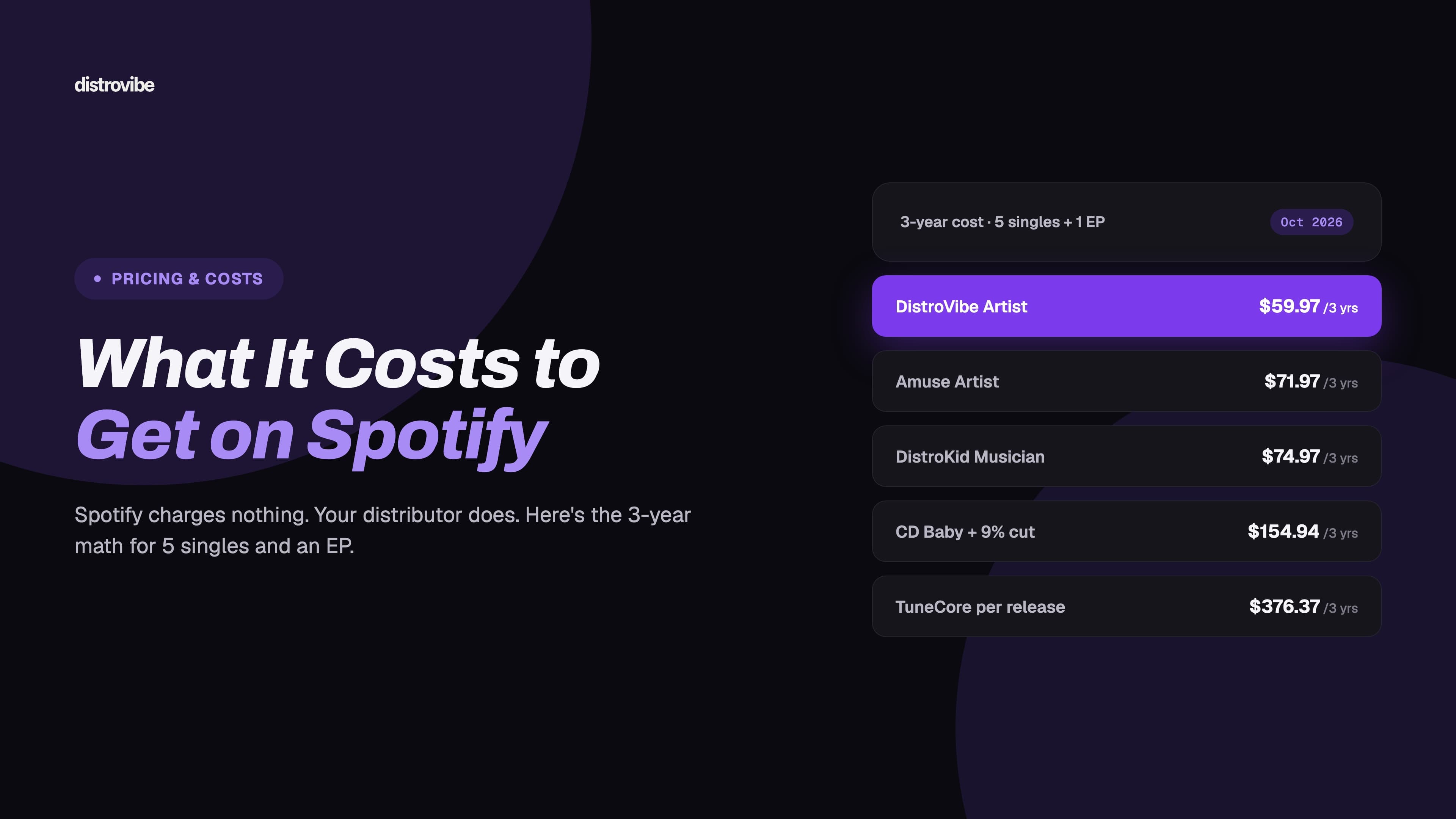
In a three-year example of 5 singles and 1 EP, DistroVibe's Artist plan costs $59.97 in total, compared with $74.97 for DistroKid Musician or TuneCore Rising Artist and $71.97 for Amuse Artist.
CD Baby has the lowest upfront fee per release ($9.99 per single), but CD Baby keeps 9% of digital distribution revenue, so its total cost rises as your streams grow.
Commissions on YouTube, TikTok and Instagram, paid add-ons and fees to keep releases live are the costs artists most often miss when comparing music distribution cost in 2026.
Is it free to put music on Spotify?
Uploading to Spotify itself is free, but an independent artist cannot normally upload directly, so in practice you pay a distributor. Spotify's help page on getting music on Spotify tells artists to work with a distributor, and signed artists are usually covered by their label's distributor.
A distributor does the technical work Spotify needs: it packages your audio, artwork and metadata, assigns codes such as ISRCs and UPCs, delivers the release to Spotify and other stores, and collects your royalties. Spotify's royalties page confirms that recording royalties are paid through the licensor that delivered the music, typically a label or distributor. That is why the distributor, not Spotify, sets what you pay.
So when artists ask "how much does it cost to put music on Spotify?", the honest answer is: as much as your distributor charges, plus anything you choose to spend on recording, mixing, mastering, artwork and promotion. None of those extras are required by Spotify. If you have never released before, our guide on how to upload music to Spotify for your first release walks through the full process.
The four ways distributors charge for Spotify uploads
Every distributor uses one of four cost models, or a mix of them, and the right one depends on how often you release and how much you expect to earn.
1. Subscription (yearly or monthly)
A subscription distributor charges a flat fee per year or per month and usually lets you release unlimited music. You keep most or all of your streaming royalties. DistroVibe, DistroKid, Amuse and TuneCore's Unlimited plans all work this way. The subscription model is usually the cheapest option for artists who release more than once or twice a year.
2. Per-release fee
A per-release distributor charges for each single or album. Some charge once, like CD Baby; others charge every year, like TuneCore's pay-per-release option. Per-release pricing suits artists who release rarely, but the cost grows with every new song.
3. Commission on royalties
A commission distributor keeps a percentage of the money your music earns. CD Baby combines a one-time fee with a 9% commission on digital distribution revenue. Some subscription distributors also take a commission on specific income, such as YouTube Content ID or social platforms. A commission costs little when you earn little, and a lot when a song takes off.
4. Free with a cut
A free distributor charges no upfront fee and earns money by keeping a larger share of your royalties, or by charging for features you will want later. RouteNote, for example, advertises free worldwide distribution on its pricing page alongside paid options; check its current terms for the exact revenue share. We cover the trade-offs in detail in Free music distribution: is it really free?
What each distributor charges in October 2026
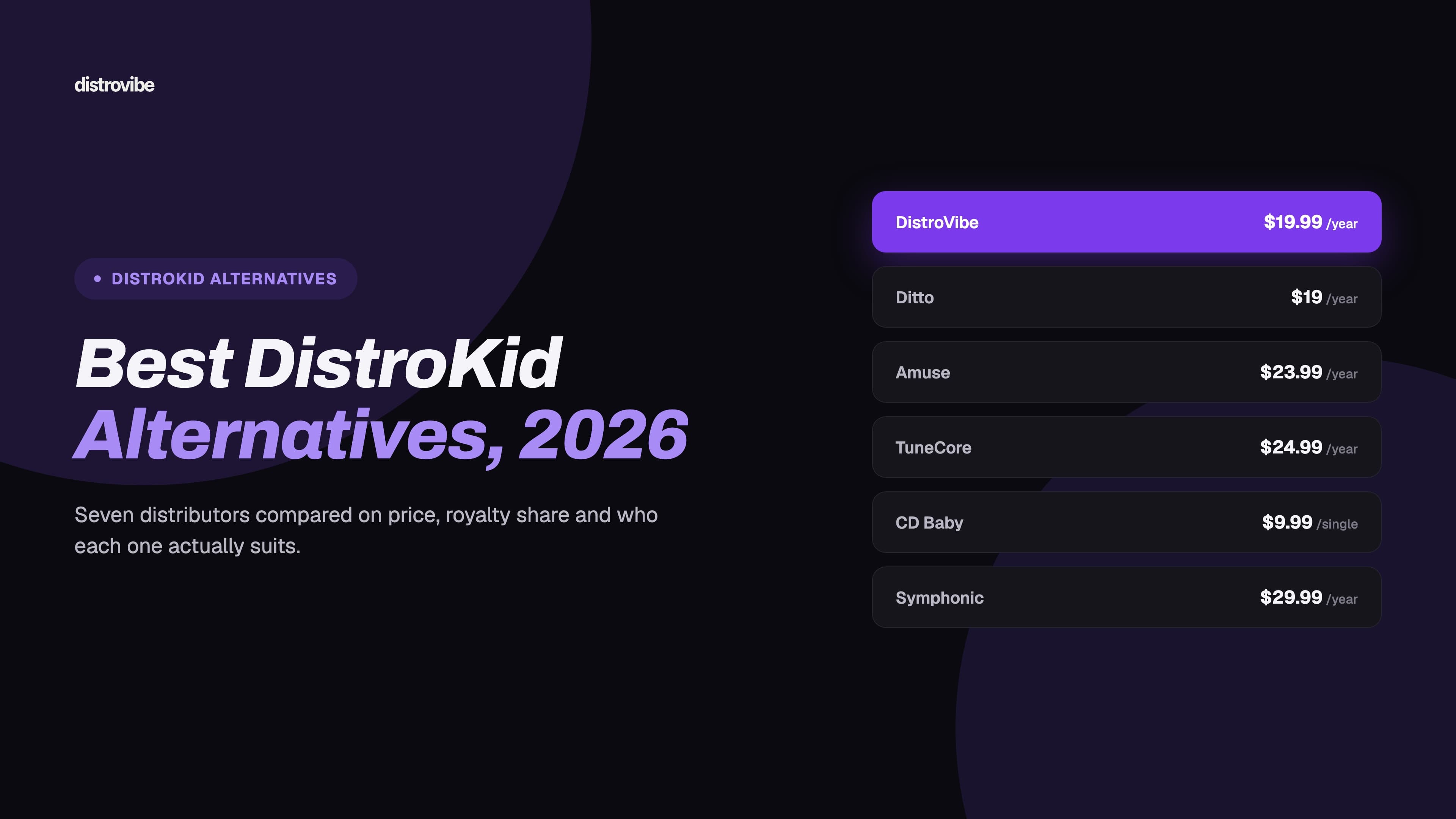
As of October 2026, the entry plans of the five distributors below cost between $19.99 and $24.99 per year for subscriptions, or $9.99 per single for CD Baby's one-time fee.
Distributor | Cost model | Entry price (Oct 2026) | Royalty share | Source |
|---|---|---|---|---|
DistroVibe | Subscription, monthly or yearly | Artist: $1.99/month or $19.99/year, unlimited releases | 100% of streaming royalties | |
DistroKid | Yearly subscription | Musician: $24.99/year, 1 artist | 100% of earnings, per DistroKid | |
TuneCore | Yearly subscription or pay per release | Rising Artist: $24.99/year; single $24.99/year; album $44.99 first year, then $56.49/year | 20% fee on TikTok, Facebook, Instagram and YouTube earnings | |
CD Baby | One-time fee per release + commission | $9.99 per single, $14.99 per album, no annual fees | 91% of digital distribution revenue (CD Baby keeps 9%) | |
Amuse | Yearly subscription | Artist: $23.99/year, 1 artist | 100%, except a 15% fee on YouTube Content ID on the Artist tier |
All prices are in USD. DistroVibe applies automatic regional purchasing-parity discounts in many countries, shown at checkout. Distributors change prices from time to time, so check each pricing page before you buy. If you only want a ranking of the lowest prices on the market, see our cheapest music distribution platforms of 2026.
The real cost over 3 years: a worked example
Over three years, an artist releasing 5 singles and 1 EP pays $59.97 on DistroVibe's Artist plan and between $64.94 and $376.37 elsewhere, before commissions are counted.
Here is the scenario. One solo artist releases 2 singles in year 1, 2 singles and a 5-track EP in year 2, and 1 single in year 3. Every release stays live until the end of year 3. Over the three years, the catalog earns $1,000 in streaming royalties. We use each distributor's entry plan for one artist, and we treat the EP as an album where a distributor prices singles and albums differently.
Distributor and plan | How the fees add up | Fees over 3 years | Commission on $1,000 royalties | Total 3-year cost |
|---|---|---|---|---|
DistroVibe Artist (yearly) | 3 × $19.99 | $59.97 | $0 | $59.97 |
DistroVibe Artist (monthly) | 36 × $1.99 | $71.64 | $0 | $71.64 |
Amuse Artist | 3 × $23.99 | $71.97 | $0 | $71.97 |
DistroKid Musician | 3 × $24.99 | $74.97 | $0 | $74.97 |
TuneCore Rising Artist | 3 × $24.99 | $74.97 | $0 on streaming | $74.97 |
CD Baby | 5 × $9.99 + 1 × $14.99 | $64.94 | 9% = $90.00 | $154.94 |
TuneCore pay per release | 11 single-years × $24.99 + EP ($44.99 + $56.49) | $376.37 | $0 on streaming | $376.37 |
The TuneCore pay-per-release line needs a little explanation. A single costs $24.99 per year it stays live. The two year-1 singles are live for 3 years (6 single-years), the two year-2 singles for 2 years (4 single-years) and the year-3 single for 1 year, which makes 11 single-years, or $274.89. The EP costs $44.99 in its first year and $56.49 in its second, or $101.48. Together that is $376.37.
Three lessons come out of this table:
Subscriptions win for regular releasers. Once you release more than a couple of songs a year, a flat yearly fee with unlimited releases beats paying per song.
Commissions scale with success. CD Baby's fees are low upfront, but at $1,000 of royalties the 9% commission already costs more than the fees. At $10,000 of royalties, the same 9% would be $900.
Small yearly differences compound. The gap between $19.99 and $24.99 is only $5 a year, but it applies every year you keep your catalog live.
To be fair to CD Baby, the per-release model can be the cheapest choice in one case: an artist with a single release and modest earnings. One CD Baby single costs $9.99 plus 9% of royalties. Over three years, that is cheaper than DistroVibe's $59.97 as long as the single earns less than about $555 (because $9.99 + 9% × $555 ≈ $59.94). Above that, the subscription comes out ahead.
If you plan to release regularly and want to keep every streaming dollar, you can compare DistroVibe's plans and see the price for your country at checkout.
Hidden costs to check before you upload music to Spotify
The headline price is rarely the whole cost of uploading music to Spotify; add-ons, platform-specific commissions and the rules for what happens when you stop paying matter just as much.
Commissions on video and social income. As of October 2026, TuneCore lists a 20% fee on earnings from TikTok, Facebook, Instagram and YouTube, and Amuse's base Artist tier charges 15% on YouTube Content ID. If your music is used in short-form video, these cuts can add up.
Split fees for collaborators. Amuse's Artist tier charges a 15% royalty fee for collaborators who split royalties without their own Amuse subscription, according to its pricing page.
Keeping releases live. Some distributors sell an optional fee that keeps a release in stores if your subscription lapses. DistroKid calls its version Leave a Legacy, a one-time charge per release; check DistroKid's support center for the current price.
Extra artist profiles. Entry plans usually cover one artist. If you also release under a second name, check the price of the next tier.
Delivery speed. A slower review lane is fine when you plan ahead. If you often release on short notice, a faster lane may be worth paying for.
What does DistroVibe include in its price?
DistroVibe's plans include unlimited releases on every tier, delivery to 450+ platforms including Spotify, and 100% of streaming royalties, with no per-release fee.
DistroVibe plan | Monthly | Yearly | Main inclusions |
|---|---|---|---|
Artist | $1.99 | $19.99 (≈ $1.67/month) | 1 artist profile, unlimited releases, 450+ stores, 100% of streaming royalties, standard review in 5–7 days |
Artist Pro (most popular) | $2.99 | $29.99 | Everything in Artist, 3 artist profiles, Express Fast-Lane review in 24–48 hours, YouTube Content ID at 0% commission, official VEVO channel and music video delivery |
Label | $5.99 | $59.99 | Unlimited artist profiles, custom DDEX party name and imprint, automated royalty and commission split accounting, bulk CSV catalog ingestion, dedicated account manager |
Label Pro | $14.99 | $149.99 | Everything in Label, developer API (rolling out), priority technical support |
Every DistroVibe plan also includes royalty splits with collaborators and SmartLinks, so you can share one pre-release or release page that sends fans to their favorite store. Monthly plans are billed month-to-month, and the yearly plans cost less over a full year. As of October 2026, DistroVibe serves more than 1,000 active catalogs.
What's the catch?
DistroVibe is cheaper than most subscription distributors, and there are honest trade-offs to know before you choose it.
DistroVibe is a younger company. TuneCore and CD Baby have been distributing music for far longer and have a longer track record. If a long history matters most to you, weigh that.
YouTube Content ID needs Artist Pro. DistroVibe's base Artist plan does not include Content ID. On Artist Pro ($2.99/month or $29.99/year) and above, Content ID is included at 0% commission.
Standard review takes 5–7 days on the Artist plan. Plan your release date at least a week or two ahead, or choose Artist Pro for the 24–48 hour Express Fast-Lane.
Already distributing somewhere else? You don't have to start from zero. DistroVibe supports switching distributors while keeping your streams by reusing the same ISRC and UPC codes. See switching to DistroVibe.
If you are leaving DistroKid in particular, our roundup of the best DistroKid alternatives in 2026 compares more options side by side.
How to get started on DistroVibe
Putting your first release on Spotify through DistroVibe takes six steps.
Create your account on the DistroVibe sign-up page with your name, email and a password, then enter the 6-digit verification code DistroVibe emails you.
Verify your identity and accept the distribution agreement during onboarding.
Pick a plan: Artist, Artist Pro, Label or Label Pro, billed monthly or yearly.
Upload your audio and artwork and fill in the track details, such as titles, credits and contributors.
Choose your stores and set a release date, then review everything and submit the release.
Share a SmartLink so fans can find the release on Spotify and every other platform.
FAQ
How much does it cost to put a song on Spotify?
Spotify itself charges nothing. As of October 2026, putting one song on Spotify through a distributor costs from $9.99 one time (CD Baby, plus a 9% commission) to around $20–$25 a year for unlimited releases on a subscription such as DistroVibe ($19.99/year), Amuse ($23.99/year) or DistroKid ($24.99/year).
Can I upload music to Spotify directly for free?
Independent artists normally can't upload directly to Spotify. Spotify's help center directs artists to a distributor. Some distributors offer free plans, but they usually keep a larger share of your royalties or charge for important features.
Is a subscription or a one-time fee cheaper for music distribution?
A subscription is usually cheaper if you release several songs a year, because unlimited releases cost the same as one. A one-time fee per release can be cheaper if you release a single song that earns little, but commissions make it more expensive as your streams grow.
Does Spotify take a cut of my royalties?
Spotify pays royalties to the rightsholders through the distributor or label that delivered the music. Your distributor then pays you according to its terms. With a 100% royalty distributor, such as DistroVibe on streaming royalties, the distributor does not keep a share of what Spotify pays.
What is the cheapest way to put music on Spotify in 2026?
For an artist who releases more than once a year, a low-cost unlimited subscription is usually the cheapest way. As of October 2026, DistroVibe's Artist plan costs $19.99 per year, or $1.99 per month, with unlimited releases and 100% of streaming royalties.
Do I have to pay every year to keep my music on Spotify?
It depends on the distributor. Subscription distributors charge every year or month for as long as you use the service, and per-release models such as TuneCore's also renew yearly. CD Baby charges once per release with no annual fees, but it keeps 9% of digital revenue.
Start releasing for less
Spotify doesn't charge you to be there, so the only real choice is how your distributor charges. DistroVibe starts at $1.99 per month with unlimited releases and 100% of your streaming royalties. Create your DistroVibe account or compare the plans to see the price in your country.