CD Baby and Distrovibe solve the same basic problem, getting your music onto Spotify, Apple Music, and everywhere else, but they charge for it in almost opposite ways. CD Baby is a one-time fee with an ongoing commission. Distrovibe is a flat annual fee with no commission at all. Neither model is a trick, but which one actually costs you less depends on details most comparison pages skip over.
The Core Difference: How You Pay
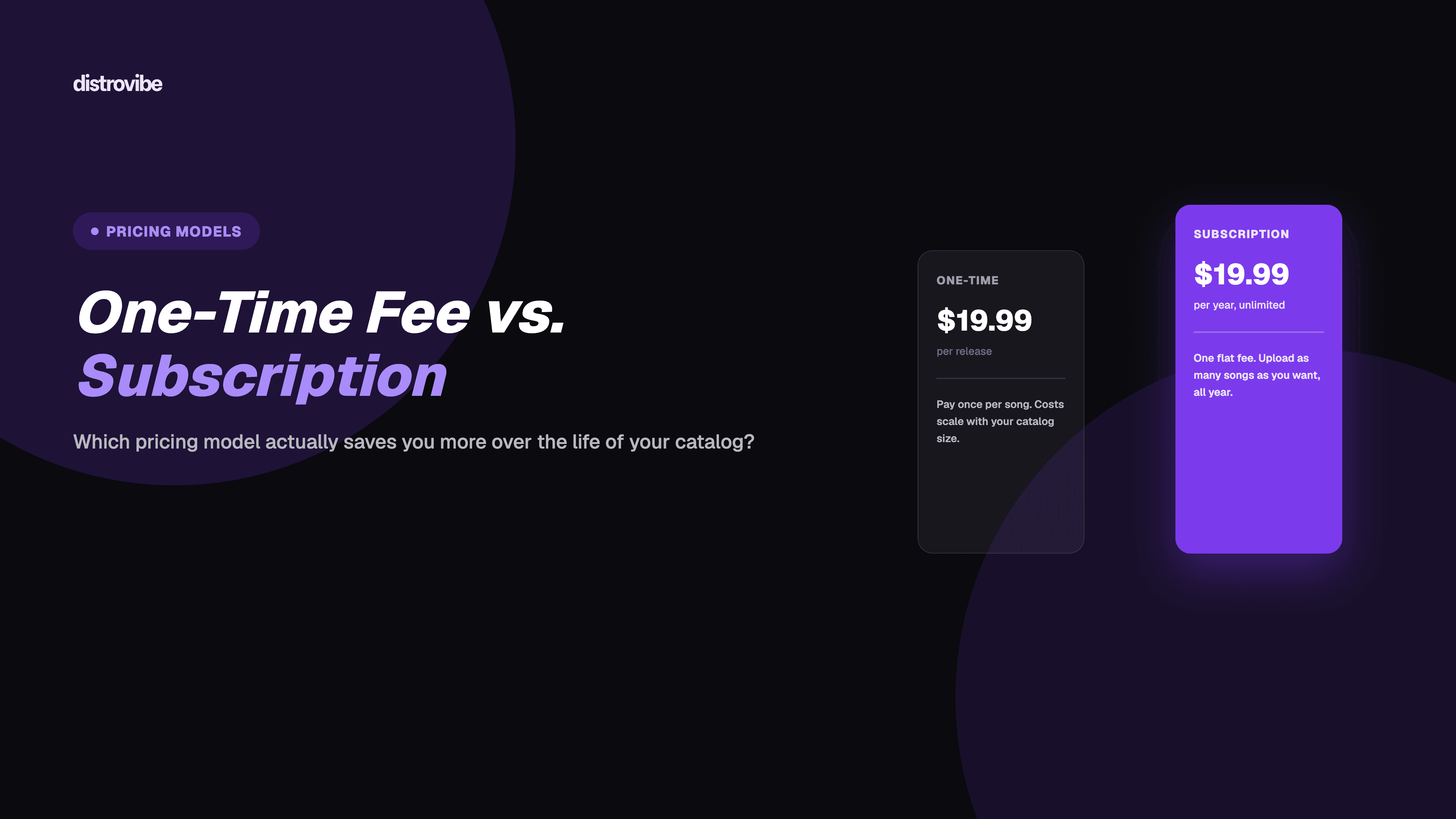
CD Baby charges $9.99 for a single or $14.99 for an album, paid once, with no subscription and no renewal fee, ever. In exchange, CD Baby keeps roughly 9% of your royalties for as long as that release keeps earning money.
Distrovibe charges a flat annual fee, $19.99/year for the Artist plan, and keeps 0% of your royalties. You get unlimited uploads for that price, not a per-release charge, and 100% of what your music earns goes to you.
That single difference, upfront-plus-commission versus flat-fee-plus-100%, is what everything else in this comparison comes back to.
When CD Baby's Model Actually Wins
If you release rarely and don't expect a track to earn much, CD Baby is hard to beat. Pay $9.99 once, the song stays live indefinitely, and if it only ever earns a modest amount, a 9% cut of a small number is a small number. An artist who puts out one single a year and treats it as a hobby is very plausibly better off with CD Baby's one-time fee than with any annual subscription.
The permanent hosting is also worth being honest about: with CD Baby, there's no subscription to forget to renew and no risk of a catalog coming down because a payment lapsed. That's a real advantage for anyone who wants to set a release live once and never think about billing again.
When Distrovibe's Model Actually Wins
The commission is the part that changes the math once a release starts actually performing. A 9% cut sounds small until you attach it to a track that's earning real, sustained streaming income over several years, at which point it adds up to considerably more than a $19.99 annual fee ever would. With Distrovibe, the fee is the same whether a track earns $50 or $50,000 in a year, because there's no commission sitting on top of it.
This math flips even faster if you release more than once a year. CD Baby's fee is per release, so four singles a year is roughly $40 before any commission is even factored in. Distrovibe's Artist plan covers unlimited uploads for $19.99/year regardless of how many tracks you put out, so an artist releasing consistently is paying less upfront and keeping 100% of everything on top of that.
Feature Comparison Beyond Price
Royalty splits. Distrovibe includes split payments as a standard feature, letting collaborators get paid automatically and correctly from the first stream without manual accounting. CD Baby offers royalty splitting as well, but it's worth checking current terms directly, since split-handling tools and their availability by plan tier are exactly the kind of detail that changes between platforms' pricing pages over time.
Lyrics distribution. Distrovibe delivers synced and static lyrics to platforms like Apple Music and Musixmatch as part of standard distribution. This is a smaller feature on paper but a real discoverability factor, since lyric search is a meaningful entry point for new listeners finding a track for the first time.
Playlist pitching. Distrovibe includes Priority Pitch on every plan at no extra cost, meaning the Distrovibe team pitches your release directly to Spotify's editorial team in addition to your own Spotify for Artists pitch. This runs alongside, not instead of, your own pitching efforts.
Platform reach. Both platforms deliver to the major DSPs, Spotify, Apple Music, YouTube Music, Amazon Music, Deezer, TikTok, and more. CD Baby has additionally been in the physical distribution and sync licensing space for a long time, and it has real, longstanding relationships there that a newer platform like Distrovibe doesn't have the same track record in yet. If physical CD distribution or a specific sync licensing service is central to your release strategy, that history is a legitimate factor in CD Baby's favor.
Catalog longevity. With CD Baby, a paid release stays up permanently with no ongoing subscription required. With Distrovibe, keeping a catalog live depends on maintaining an active annual subscription, the same tradeoff most flat-fee distributors (DistroKid, Amuse, Ditto Music) share.
A Rough Break-Even Way to Think About It
If you're trying to decide which model actually saves you money, the rough question is: how much do you expect a given release to earn over its lifetime, and how many releases are you putting out per year?
Low release frequency, modest expected earnings: CD Baby's one-time fee is very likely cheaper.
Regular release schedule (multiple tracks a year), any earnings level: Distrovibe's flat annual fee is very likely cheaper, since the per-release cost keeps compounding on CD Baby's side.
A single release you expect to genuinely take off: Distrovibe's 0% commission wins over any meaningful time horizon, since CD Baby's 9% never stops being charged.
There's no version of this where one platform is objectively cheaper for everyone. It depends on your specific release pattern, and being honest about that pattern before choosing is worth more than any single number on either homepage.
The Bottom Line
CD Baby and Distrovibe aren't really competing on the same axis. CD Baby is built for artists who release occasionally and want to pay once and forget about it. Distrovibe is built for artists who release consistently, want to keep 100% of what they earn regardless of how a track performs, and want split payments, lyrics distribution, and playlist pitching included rather than sold separately. Neither answer is universally right, but knowing which release pattern you actually have makes the choice a lot less confusing than either homepage makes it look.
If the flat-fee, 100%-royalty model sounds like the better fit for how you release, you can see the full Distrovibe pricing breakdown or create an account to get started.