Every distributor's homepage says some version of "the cheapest way to release your music." Almost none of them show you the number that actually matters: what you pay over a full year of realistic use, once renewals, per-release fees, and add-ons are factored in. The headline price and the real price are often two different numbers.
This is an attempt at an honest one. We're including Distrovibe in this comparison, because we'd rather you pick the distributor that actually fits your release habits than pretend every artist's situation looks the same. If you already know your release pace and want the short version, our pricing page breaks down all three Distrovibe tiers side by side.
Why "Cheapest" Isn't One Number
Distributors use three fundamentally different pricing models, and which one is cheapest depends entirely on how you release:
Flat annual subscription, unlimited uploads. You pay once a year regardless of how many releases you put out. Great if you release often; expensive if you release once a year.
Per-release fee. You pay once per single or album, no subscription. Often includes permanent hosting, so your music stays live even if you never pay again. Better for artists who release rarely.
Commission-based. Little or nothing upfront, but the platform keeps a percentage of your royalties indefinitely. Cheapest at first, most expensive over a long, successful catalog life.
None of these is objectively "the cheapest." It depends on your release frequency and how long you expect a track to keep earning.
The Platforms, Compared
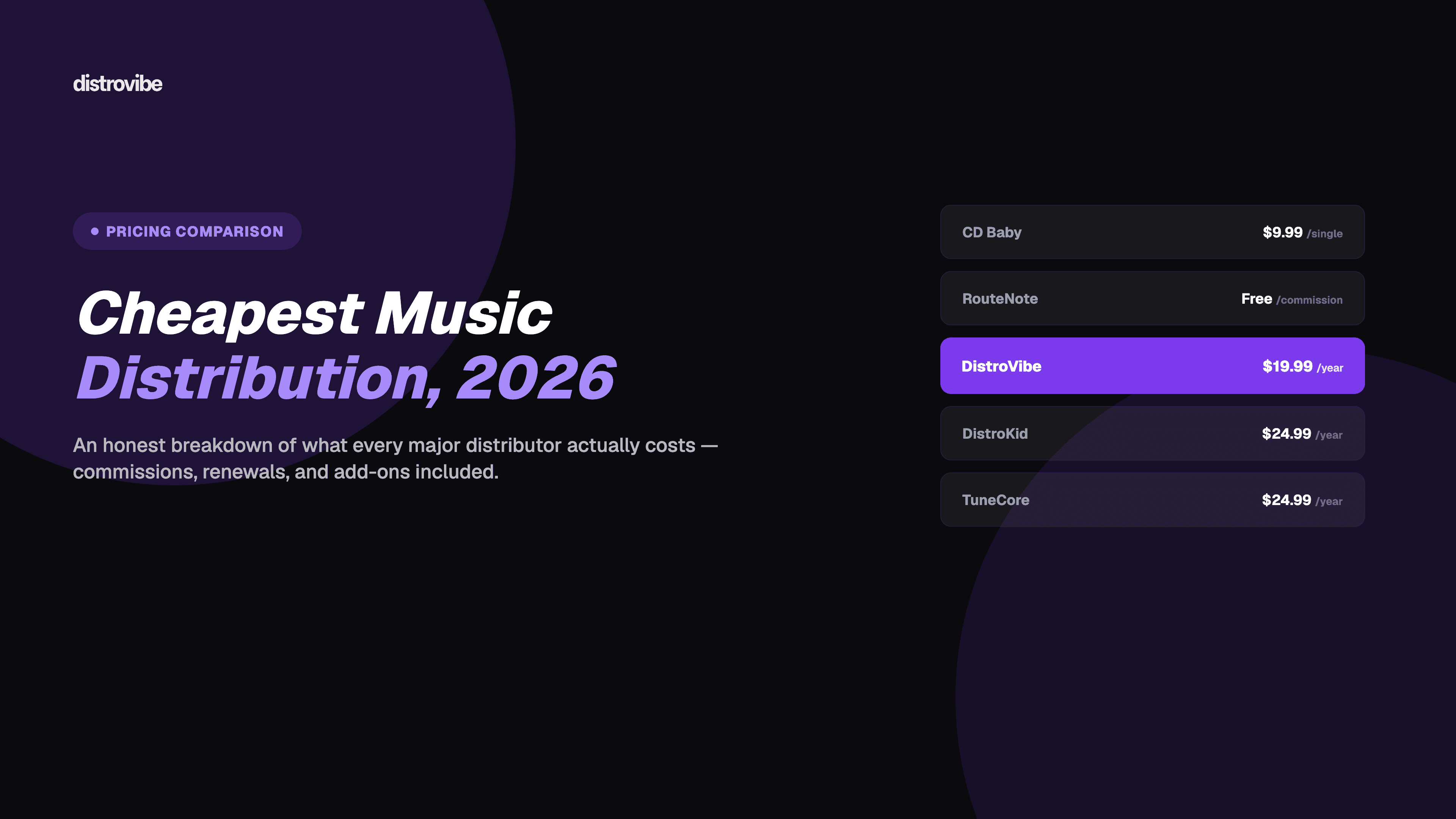
Platform | Entry price | Pricing model | Royalty retention | The catch |
|---|---|---|---|---|
CD Baby | $9.99/single or $14.99/album (one-time) | Per-release, permanent hosting, no subscription | ~91% (9% commission, ongoing) | Commission never ends, and grows with your success |
RouteNote | Free, or $10/single–$45/extended album (paid tier) | Free = commission-based; paid tier = per-release, one-time | ~85% on free tier / 100% on paid tier | Free tier gives up a meaningful royalty cut permanently |
Ditto Music | €19/year (Starter, 1 artist) | Flat annual, unlimited uploads | 100% | Sync pitching, publishing, and Content ID need the €59/year Pro tier |
Distrovibe | Flat annual, unlimited uploads | 100% | Higher tiers needed for multi-artist / label use | |
Amuse | $23.99/year (Artist, 1 artist) | Flat annual, unlimited uploads | 100% | Hi-Res audio and fan email tools need the $39.99/year Artist Plus tier |
TuneCore | $24.99/year (Rising Artist, unlimited) | Flat annual, unlimited uploads (also offers per-release pricing) | 100% | Advanced features (sync pitching, faster delivery) need the $44.99–$54.99/year tiers |
DistroKid | $24.99/year (Musician, 1 artist) | Flat annual, unlimited uploads | 100% | Multi-artist tiers run $44.99–$89.99/year; catalog comes down ~30 days after cancellation |
(Sorted low to high by realistic single-artist entry cost. Ditto Music prices in EUR; at current exchange rates €19 is roughly $21–22 USD. Higher tiers for every platform scale up for multi-artist or label use, so check the notes below before assuming the entry price is what you'll actually pay.)
CD Baby. $9.99 for a single, $14.99 for an album, paid once, with no subscription fee at all. No renewal, ever, but the trade-off is a 9% commission on royalties that continues for as long as the release earns money. Genuinely cheap for a low-volume, modestly-earning catalog; the more a release actually earns, the more that 9% adds up over the years. (See how this stacks up against Distrovibe's flat fee in our CD Baby comparison.)
RouteNote. The only platform on this list with a real free tier, though it comes with a meaningful royalty cut (roughly 85% retention) for as long as the release earns. The paid, per-release alternative runs $10 for a single, $20 for an EP, $30 for an album, and $45 for an extended album, all one-time, with 100% royalty retention. Worth comparing directly against CD Baby's per-release pricing since the models are similar.
Ditto Music. Starter plan at €19/year covers unlimited releases for one artist, 150+ platforms, auto-split royalty payments, and playlist submission, roughly on par with Distrovibe and Amuse's entry tiers once converted to USD. The Pro tier at €59/year adds sync licensing pitches, publishing royalty collection, and YouTube Content ID, which is where the real cost difference between Ditto and its competitors shows up. Labels tier runs €89/year for up to 5 artists.
Distrovibe. Artist plan at $19.99/year, Artist Pro at $29.99/year, Label at $59.99/year, all unlimited uploads with 100% royalty retention on paid tiers. Sits at or just below DistroKid's and TuneCore's entry price (see our full DistroKid comparison for a feature-by-feature breakdown). The clearer differentiator isn't the base price. It's that split payments and lyrics distribution are included rather than billed as separate add-ons, so the number on the pricing page is closer to what you actually pay. You can see the full plan breakdown, including what unlocks at each tier, before creating an account.
Amuse. Artist plan at $23.99/year covers one artist, with ASAP 24-hour releases, daily streaming insights, and royalty advances. Artist Plus at $39.99/year adds a second artist slot, fan email collection, and Hi-Res audio distribution. Professional at $59.99/year covers three artists with priority support. No free tier anymore, and reaches a somewhat smaller store list than the largest competitors.
TuneCore. Two ways to buy in: a flat annual "artist plan" starting at $24.99/year (Rising Artist, unlimited uploads to 150+ stores), scaling to $44.99/year (Breakthrough Artist, more customization) and $54.99/year (Professional, built for labels), or a per-release model at $24.99/year for a single and $44.99 the first year for an album, which then renews at $56.49 in subsequent years. That renewal jump on the per-release album option is easy to miss if you're comparing based on the first-year price alone.
DistroKid. Musician plan at $24.99/year covers one artist with unlimited uploads and royalty splits. Musician Plus at $44.99/year adds a second artist name, synced lyrics in Apple Music, and daily streaming stats. Ultimate at $89.99/year covers five or more artists. Often the fastest to deliver and one of the more recognizable names, but the real annual cost climbs quickly once you need more than one artist name, and the catalog comes down about 30 days after cancellation unless you pay per-release to keep it live.
So What's Actually Cheapest for You?
You release once or twice a year and don't expect huge streaming numbers: CD Baby ($9.99/single, $14.99/album) or RouteNote's free tier. Paying once, or nothing, beats an annual subscription when you're not releasing often enough to justify it.
You release consistently, several times a year, with an ongoing catalog: A flat annual subscription model (DistroKid, Amuse, Ditto, TuneCore, or Distrovibe) wins, because the cost stays fixed no matter how many tracks you put out. At this release pace, per-release models like RouteNote's paid tier or TuneCore's single/album pricing start compounding into a larger total than a flat annual fee. This is the release pattern Distrovibe's Artist and Artist Pro tiers are built around: unlimited uploads at one flat price, with split payments included if you're collaborating.
You expect a release to genuinely take off and earn significant streaming income over years: Avoid commission-based models (CD Baby's 9%, RouteNote's free-tier commission) for that specific release. A flat annual fee with 100% royalty retention costs the same whether the track earns $50 or $50,000. Commission models don't.
You manage more than one artist or a small roster: Compare the multi-artist tiers specifically, not the entry-level price every homepage leads with. At two artists, DistroKid ($44.99), Amuse ($39.99), and Ditto (€59) land in a fairly similar range once converted to the same currency; Distrovibe's Label plan at $59.99/year is worth lining up against whichever of those fits your artist count.
A Note on Pricing Accuracy
Every distributor on this list changes pricing, promotions, and plan structures more often than most artists check. The figures above reflect publicly listed pricing as of this article's publish date. Before choosing based on price alone, confirm current rates directly on each platform's pricing page, since a single promotional change can shift which option is actually cheapest for your situation.
There's no single cheapest distributor. There's a cheapest distributor for your specific release frequency, catalog size, and how long you expect a track to keep earning. Low-volume artists are usually better off with a one-time or free-tier model; consistent releasers are almost always better off with a flat annual subscription, regardless of which one they pick. The honest advice is less exciting than a homepage price, but it's the one that actually saves money over a real year of releasing.
If a flat annual fee with everything included sounds like the right fit, you can see the full Distrovibe pricing breakdown or start distributing directly.