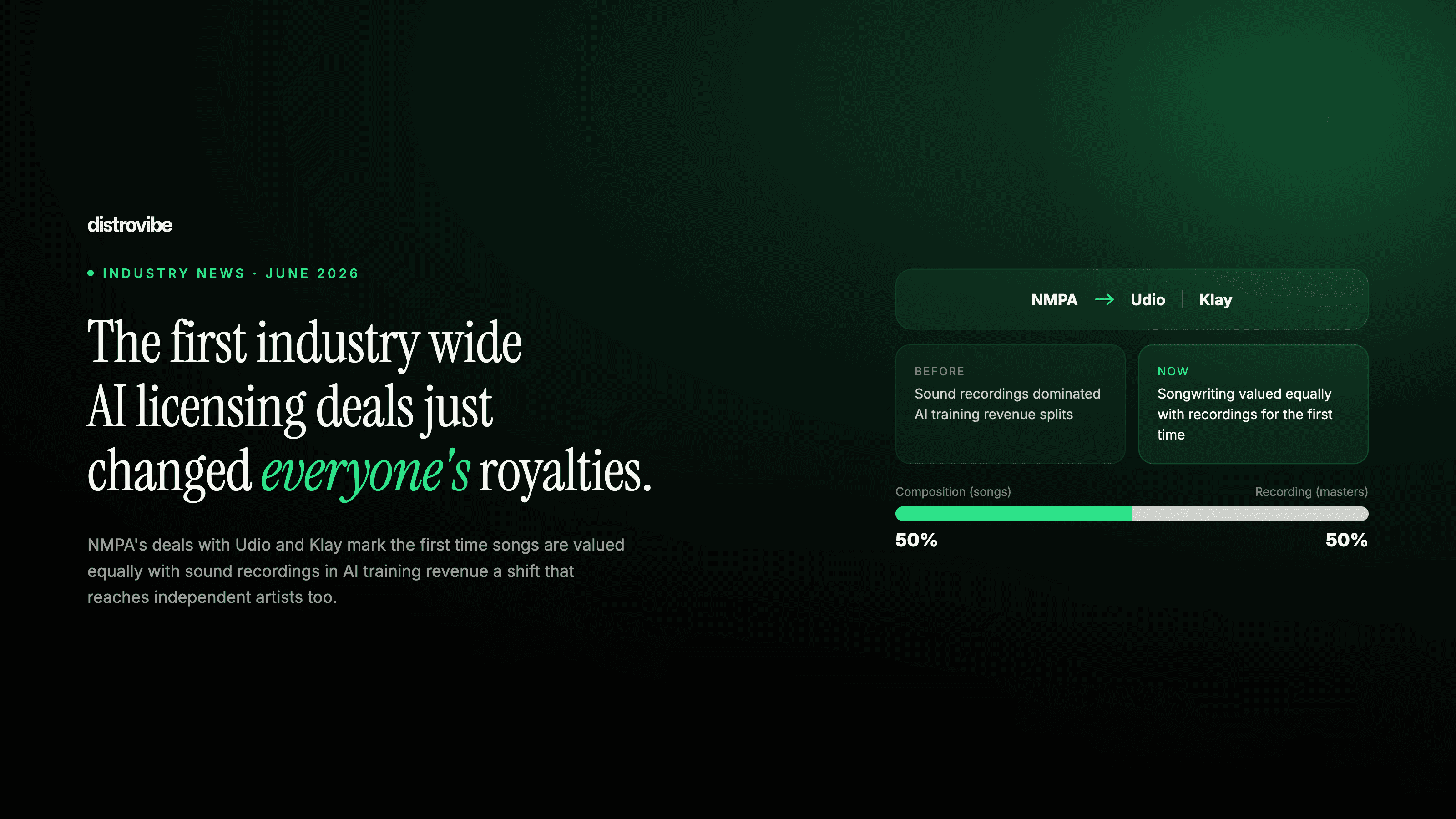
On June 10, 2026, at its annual meeting in New York, the National Music Publishers' Association (NMPA) announced something the music industry has never had before: an industry-wide licensing template that lets publishers license their entire catalogs to AI music companies with songs and recordings valued equally for the first time in AI training history.
If that sounds like inside-baseball trade news, it isn't. This deal reshapes how AI companies pay for the music that trains their models, and it sets a precedent that will directly affect independent artists and songwriters for years to come whether or not you've ever heard of the NMPA. Let's unpack what actually happened, why the "equal value" detail is such a big deal, and what it means for your own catalog.
What Was Actually Announced
NMPA President and CEO David Israelite unveiled two agreements at the trade body's annual meeting:
1. A finalized industry-wide deal with Udio, the AI music generation platform. Israelite called it the first-ever industry-wide licensing deal struck with a major AI music company. Independent U.S. publishers can now opt into this template agreement instead of negotiating with Udio individually a process that would otherwise be far too slow and expensive for smaller rights holders.
2. An agreement in principle with Klay, a newer AI platform building what it calls a Large Music Model. Klay's deal is notable for a different reason: it secured licenses from all three major labels Sony, Universal, and Warner before launching its platform at all. That's rare in an industry where AI companies have historically launched first and licensed later, if ever.
Both deals will formally distribute income under a 50/50 split between songs (publishing) and recordings (masters) a structural change from streaming, where recordings typically earn more than three times what songs receive.
Why the 50/50 Split Actually Matters
To understand why this is being treated as a landmark moment, you need to understand the imbalance it's correcting.
In traditional streaming royalties, the master recording owner (usually the artist or label) earns significantly more than the songwriter or publisher. This has always been a sore point for songwriters especially those who write but don't perform, or who split writing credits across a track.
When AI companies train models on existing music, that imbalance was expected to simply carry over. Instead, the NMPA pushed for and got equal treatment. Israelite framed it directly: songs are just as important, if not more important, than sound recordings when it comes to AI training, since AI models learn as much from composition, melody, and lyrics as they do from a specific recorded performance.
This precedent matters beyond Udio and Klay. Once one major AI company agrees to equal valuation, it becomes the benchmark every future negotiation gets measured against including future deals with Suno, ElevenLabs, and whatever platforms emerge next.
The Context: From Lawsuits to Licenses
This deal didn't happen in a vacuum it's the resolution of a fight that started two years earlier.
In June 2024, the RIAA sued Udio and its rival Suno on behalf of Universal Music Group, Sony Music, and Warner Music Group, alleging mass copyright infringement through unlicensed AI training. That litigation began unwinding in October 2025, when Universal settled and agreed to build a licensed AI platform with Udio. Warner Music Group followed in November 2025, then independent licensing body Merlin in January 2026, and publisher Kobalt in April 2026. Sony Music remains the only major holdout, with its portion of the case still ongoing.
In response to the pressure, Udio fundamentally changed its product shifting away from generating new AI songs from scratch and toward remixing licensed, pre-existing songs. That pivot is largely why the industry came back to the table.
Klay took a cleaner path from the start, securing licenses from all three majors before ever launching publicly something Israelite specifically praised, noting how rare it is for an AI company to ask for permission before asking for forgiveness.
"Licensing Good Actors, Litigating Bad Ones"
Israelite was careful to frame this as a dual-track strategy, not a truce: "Litigating against bad AI actors and licensing good AI partners is not in conflict. NMPA will do both."
That distinction matters for independent artists trying to make sense of an AI landscape that can feel like total chaos. The industry isn't surrendering to AI, and it isn't rejecting it wholesale either it's drawing a clear line between:
Licensed AI platforms that pay rights holders and train on permitted music (Udio, Klay, and similarly-postured companies)
Unlicensed "bad actors" still facing litigation for training on copyrighted material without permission or compensation
For your own decision-making whether that's choosing which AI tools to use in your workflow, or deciding whether to opt your own publishing into a licensing deal this is the dividing line worth paying attention to.
What This Means If You're an Independent Artist
Here's where it gets practical.
If you're independently published (most independent artists are)
The Udio template deal is designed for exactly this scenario. Independent U.S. publishers which includes self-published songwriters and small publishing entities can review and opt into the Udio agreement without negotiating a custom deal. If you write and publish your own music, this is a licensing pathway that didn't exist a month ago.
If AI training royalties are new territory for you
This is worth understanding clearly: AI training licensing is a separate revenue stream from streaming royalties. It's not something your distributor automatically collects for you the way master royalties are. Publishing-side AI licensing runs through your publishing administrator or PRO relationship which is exactly why keeping your publishing registration current and accurate matters more with each of these deals that gets signed.
If you're wondering whether AI companies are now "safe"
Not universally, and not automatically. A platform being in licensing talks with majors doesn't mean every AI tool is operating cleanly. The American Federation of Musicians has separately alleged that major labels have failed to compensate musicians whose performances were used to train AI models a reminder that even within licensed deals, questions remain about how fairly compensation flows down to the actual creators involved, not just the rights-holding entities.
If you're watching for what comes next
Israelite announced an AI Songs Summit in Nashville this September, bringing together songwriters, publishers, and streaming services to align on AI policy going forward. Expect more deals, more precedent-setting terms, and likely movement on the legislative side including continued attention to bills like the NO FAKES Act, aimed at protecting artists' voice and likeness from unauthorized AI replication.
The Bigger Picture
This deal lands at a moment when AI's relationship with the music industry is clearly shifting from confrontation toward structured coexistence messily, unevenly, but undeniably. Two years ago, Udio was being sued for $500 million. Today, it has licensing deals with all three major labels, a major distributor, and now the trade body representing the entire U.S. publishing industry.
For independent artists, the lesson isn't that AI is now fully resolved or fully safe. It's that the terms of engagement are being actively written right now and the deals being struck this year will define the baseline that every artist, signed or independent, operates under for years to come.
Being informed about these shifts isn't optional anymore. Your publishing registration, your metadata accuracy, and your awareness of which platforms are operating on licensed terms are quickly becoming as important to your income as your release strategy.
How Distrovibe Fits In
As these industry-wide licensing structures take shape, one thing becomes clearer every month: accurate rights documentation is the foundation everything else gets built on.
At Distrovibe, we make sure every release you distribute carries clean metadata, correct ISRC/UPC codes, and accurate ownership information — the exact data trail that determines whether you're properly credited (and paid) as these new AI licensing frameworks roll out. Master rights stay yours. Publishing registration is on you to keep current. Together, that's what positions you to benefit as deals like this one continue to reshape where music industry revenue comes from.
Want your catalog distribution-ready and rights-clean for whatever comes next? Get started with Distrovibe →