White label music distribution is a model where a provider runs the delivery to Spotify, Apple Music and other stores, while a partner (a label, management company or music platform) sells that service to artists under its own brand, domain and prices. The artists sign up with the partner and never deal with the provider directly. As of October 2026, DistroVibe's white-label program costs a one-time $750 setup plus a Label Pro subscription of $14.99/month.
Key takeaways
White label music distribution splits the work: the provider handles store delivery, copyright checks and artist identity verification; the partner handles the brand, the prices, the artist relationship and artist payouts.
In DistroVibe's white-label model, artists pay their package fees directly into the partner's own payment provider account (Stripe, PayPal, Paddle and others); DistroVibe never holds or passes through that package revenue.
In DistroVibe's white-label model, store royalties for the partner's whole catalogue are credited to the partner account, and the partner pays each artist their share after the package commission.
A white-label distributor is different from a referral program: with white label, the artist is the partner's customer; with a referral, the artist becomes the distributor's customer.
As of October 2026, launching on DistroVibe's white-label program costs $750 once (after a 48-hour trial) plus Label Pro at $14.99/month or $149.99/year.
What is white label music distribution?
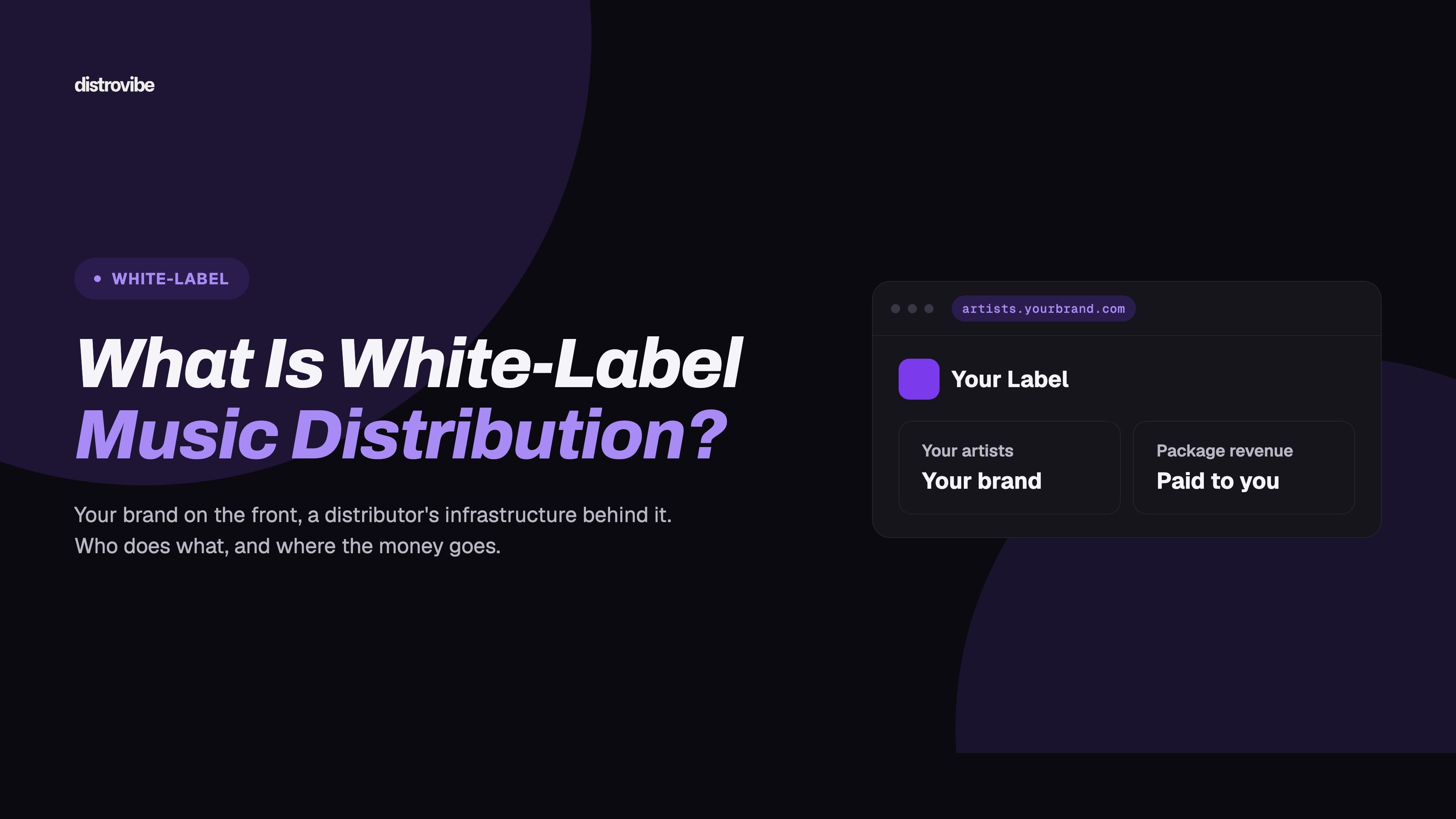
White label music distribution means selling music distribution under your own brand while another company runs the technical and store-facing side.
The term comes from retail, where one manufacturer makes a product and another company sells it with its own label on the box. In music, the "product" is the full distribution workflow: an artist sign-up page, a release upload wizard, audio and artwork checks, delivery to streaming stores, royalty reporting and payouts, packaged as a branded music distribution platform.
From the artist's point of view, they are using "YourBrand Distribution". They sign up on your domain, receive emails from your address, choose from your packages and contact you for support. Behind it, the provider delivers the releases to the stores under your label name.
Distribution itself is not optional for anyone who wants music on the major platforms. Spotify's own guidance for artists says that distributors handle music distribution and pay streaming royalties. White label is one way to own that layer for your artists without becoming a delivery company yourself.
Who does what: the partner vs the provider
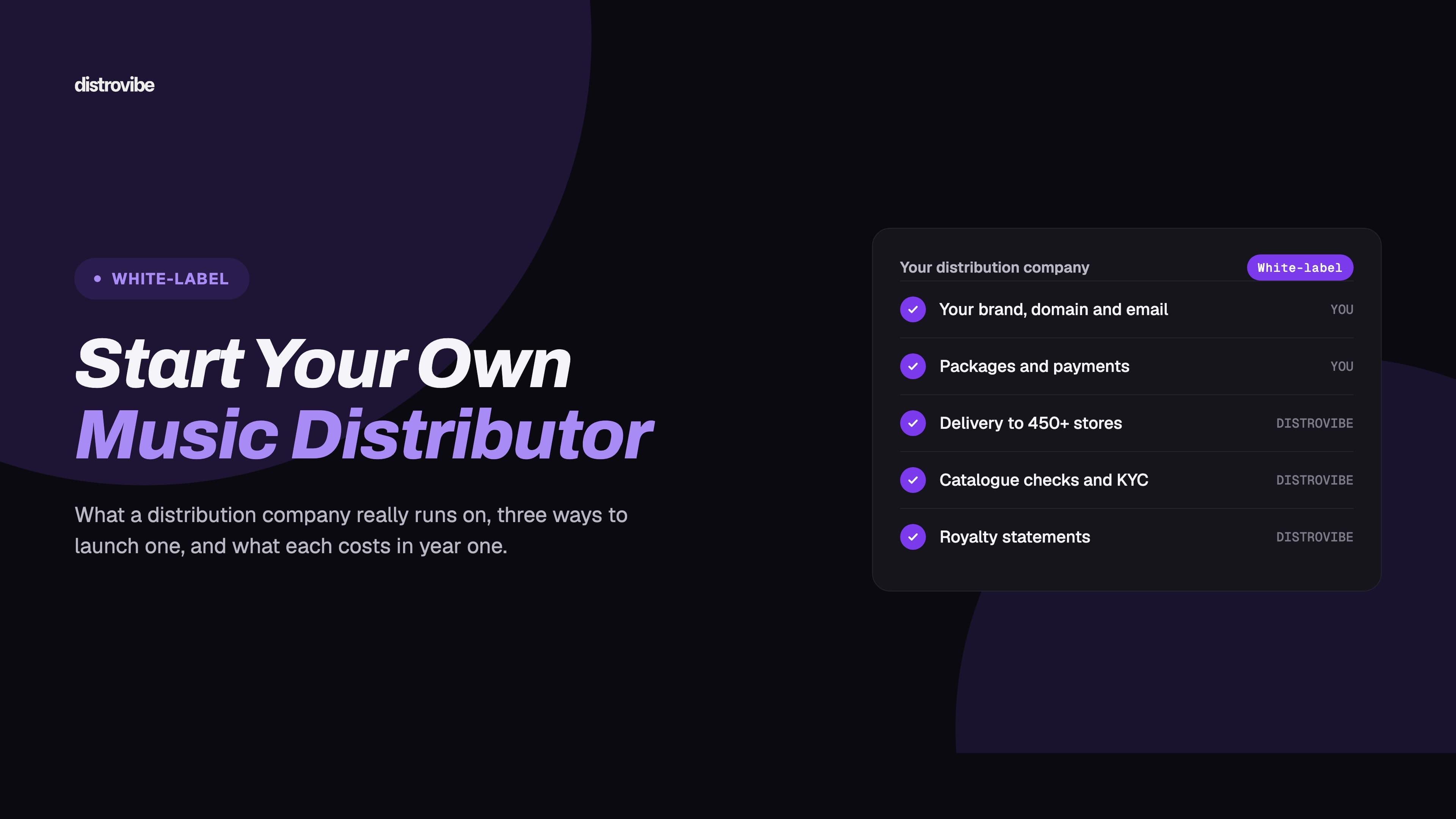
In a white label music distribution setup, the partner owns the business and the provider owns the pipes.
This is how responsibilities divide in DistroVibe's white-label program as of October 2026:
Task | Partner (you) | Provider (DistroVibe) |
|---|---|---|
Brand, logos, colours, sign-in screen, artist workspace | Designs and controls it | Supplies the tools; nothing on the portal mentions DistroVibe |
Domain and email | Adds a subdomain with one CNAME record; connects its own mail server | Issues and renews the TLS certificate |
Packages and prices | Sets free, monthly, yearly or one-time packages and the royalty commission it keeps | Enforces package limits on profiles and releases |
Collecting artist payments | Uses its own payment provider account | Never holds package revenue |
Store delivery | Its artists upload releases on the partner's portal | Delivers to 450+ stores under the partner's label name |
Copyright checks | Sees release status in the console | Checks every release against commercial catalogues before delivery |
Artist identity verification (KYC) | Sees each member's check status | Verifies every artist before first delivery, as stores require |
Paying artists | Pays artists and marks payout requests as paid | Credits store royalties to the partner account |
Artist support and relationship | Owns it | Contacts artists only when stores or the law require it |
The key idea: the partner is a real business with real customers, not an affiliate. The provider stays in the background and takes on the parts that need store agreements, compliance checks and delivery infrastructure.
How the money flows in white label music distribution
Two separate streams of money exist in white label music distribution: package fees paid by artists, and royalties paid by stores.
Stream 1: package revenue goes straight to the partner
Artists buy a package from the partner, for example a free starter tier or a monthly plan. In DistroVibe's white-label program, the partner connects its own payment provider: Stripe, PayPal, Paddle, Lemon Squeezy, Polar, Dodo Payments, iyzico, PayTR or Shopier. Packages can be priced in USD, EUR, GBP or TRY. The payment lands in the partner's account, and refunds or disputes are handled in that provider's own dashboard. DistroVibe never holds or passes through package revenue.
Stream 2: store royalties go to the partner account, then to artists
Stores pay royalties for the releases they stream and sell. In DistroVibe's white-label program, royalties for the partner's whole catalogue are credited to the partner account. Each artist's portal then shows their share: the gross royalties for their tracks, minus the commission set on their package, divided between collaborators according to their royalty splits. The artist requests a payout in the portal, the partner pays them, and the partner marks the request as paid.
A simple, hypothetical illustration of the arithmetic (not a forecast of what any partner will earn):
Step | Calculation | Amount |
|---|---|---|
Store royalties credited for one artist's tracks | Given | $100.00 |
Package commission set by the partner | 20% of $100.00 | $20.00 kept by the partner |
Net for the artist's release | $100.00 − $20.00 | $80.00 |
Royalty split: producer receives 25% | 25% of $80.00 | $20.00 to the producer |
Artist's own share | $80.00 − $20.00 | $60.00 to the artist |
The commission can be anything from 0% to 100% per package, so a partner can choose to earn from package fees, from royalties, or from both. In DistroVibe's artist portal, a payout can be requested once at least $10 is available.
What do artists see on a white-label platform?
Artists see the partner's brand everywhere they look, from the sign-in screen to the payout email.
On DistroVibe's white-label program, the partner chooses light and dark logos, a favicon, colours per theme (with contrast warnings), one of 16 typefaces and one of five corner styles. The sign-in screen can use the Minimal, Split or Showcase layout, or the premium Full-screen image, Poster and Video layouts. Inside, the artist workspace can use one of six layouts (Sidebar, Top bar, Rail, Studio, Creator, Bento) with nine overview cards the partner can show, hide and reorder. Partners can link up to ten of their own tools, such as artwork or pitching services, inside the release wizard, and post announcements to every artist.
All emails, including sign-up codes, password resets, release updates, support replies and payout notices, go out from the partner's own domain. Presets exist for Google Workspace, Microsoft 365, Zoho, Yandex 360, Amazon SES, SendGrid, Mailgun, Postmark, Brevo, Resend and any SMTP server.
One honest caveat: store deliveries use the industry's DDEX standards, which record the delivering distributor in a release's technical metadata. Someone digging into that metadata can find it. That is true for every label that releases through a distributor, white label or not.
Who white label music distribution suits, and who it doesn't
White label music distribution suits organisations that already have artists and want to own the relationship; it does not suit a single artist releasing their own music.
Good fit
Independent labels that want artists to upload and track releases themselves, under the label's name, rather than emailing files to a label manager.
Management companies that want one place for every client's catalogue, earnings and payouts.
Music schools and communities that want to offer students or members a branded way to release music.
Creator platforms and music-tech apps that want to add distribution to an existing product. DistroVibe's single sign-on works from the partner's own app (Auth0, Clerk, Supabase, Firebase, Cognito, Keycloak and other OpenID providers), so artists don't need a second password.
Poor fit
Solo artists. A normal artist plan is far cheaper and simpler. DistroVibe's Artist plan starts at $1.99/month.
Small labels that only need to release their own roster and don't want artists logging in. A label account on a distributor does that job without a portal or a payment setup.
Anyone who doesn't want to run payouts. With white label, paying artists is the partner's job.
White label vs reseller/referral vs label account vs building your own
A white-label distributor gives you the brand and the customer; a referral program gives you a link; a label account gives you a dashboard; building in-house gives you everything, including the bill.
Question | White label | Reseller / referral program | Label account on a distributor | Build in-house |
|---|---|---|---|---|
Whose brand do artists see? | Yours | The distributor's | The distributor's (if artists log in at all) | Yours |
Who owns the artist relationship? | You | The distributor | You, offline | You |
Who sets artist prices? | You | The distributor | No artist pricing; you pay the plan | You |
Where do artist payments go? | Your payment provider | The distributor | N/A | Your payment provider |
Who handles store delivery and compliance? | The provider | The distributor | The distributor | You |
Do artists upload their own releases? | Yes, on your portal | Yes, on the distributor's site | Usually the label uploads | Yes, once you build it |
Typical upfront effort | Days of setup | Minutes | Minutes | Months of development |
For a deeper look at the label-account route, see our guide to music distribution for record labels. If you are weighing the in-house route, read how to start a music distribution company.
The real cost: white label vs building a distribution platform
The cost gap between white label and building in-house is usually measured in orders of magnitude, mainly because of developer time.
Assumptions for the table below, stated plainly: the US Bureau of Labor Statistics lists a median annual wage of $135,980 for software developers (May 2025 data). The in-house column assumes an illustrative 12 developer-months for a minimum product (sign-up, upload wizard, file checks, delivery integration, royalty imports and payouts), counts salary only and excludes benefits, hosting, store agreements, compliance staff and ongoing maintenance. Real projects vary widely.
Year-one cost item | DistroVibe white label (monthly Label Pro) | DistroVibe white label (yearly Label Pro) | Build in-house (illustrative) |
|---|---|---|---|
Setup / development | $750 one-time | $750 one-time | $135,980 (12 developer-months at the BLS median) |
Platform subscription | 12 × $14.99 = $179.88 | $149.99 | Hosting, storage, delivery costs not included |
Year-one total | $929.88 | $899.99 | $135,980+ |
Year-two total | $179.88 | $149.99 | Maintenance and staff, not estimated |
Even if a team built a minimum product in a quarter of that time, the salary cost alone (about $34,000) would still be roughly 37 times DistroVibe's year-one white-label cost. The in-house route also needs its own delivery arrangements with stores, which white label lets you skip by using DistroVibe's store agreements.
If owning the brand without building the pipes sounds right for you, you can apply for DistroVibe's white-label program; it takes about five minutes.
How DistroVibe's white-label program works end to end
DistroVibe's white-label program runs from application to live portal in four stages, and the partner can explore the console for 48 hours before paying the setup fee.
Behind the portal: what DistroVibe runs
Delivery to 450+ stores, including Spotify, Apple Music, YouTube Music, TikTok, Deezer and Amazon, under the partner's label name. Selected packages can release under the artist's own imprint.
Copyright checks on every release against commercial catalogues before delivery.
Identity verification of every artist before first delivery. Identity documents are encrypted.
Upload checks: masters must be lossless WAV or FLAC at 44.1 kHz or higher, audio files up to 2 GB, and cover art at least 3000 × 3000.
Two-factor sign-in and new-device alerts for the partner's team.
In the partner console: what you run
Releases grouped by status, and search across releases, artists, members and transactions.
Members with their package and identity check status.
Revenue and streams for the whole catalogue, a wallet with payouts to your bank, and a queue of artist payout requests.
Staff roles that can be limited to specific artists, label names, announcements and the DistroVibe Developer API.
Artists get monthly statements, a CSV export, royalty splits with collaborators, and streams, top stores and top countries for each release. For a checklist of what to ask any provider, read how to choose a white-label music distributor.
What's the catch?
The main catch of white label music distribution is that you become responsible for a real customer business, including support and artist payouts.
You pay your artists. Store royalties arrive in your partner account, and paying artists on time is your job. Plan for that cash-handling and bookkeeping work.
The setup fee and subscription are ongoing commitments. The $750 setup is paid once after the 48-hour trial, and the Label Pro subscription ($14.99/month or $149.99/year, see pricing) keeps the platform and your label account running.
Artists will hear from DistroVibe in specific cases. Stores require identity verification, so DistroVibe verifies every artist before their first delivery. Beyond what stores or the law require, DistroVibe doesn't contact your artists.
You need a subdomain. A root domain such as yourbrand.com can't hold the required CNAME record; use something like artists.yourbrand.com. Up to three domains are allowed per platform.
Full invisibility isn't possible. As noted above, DDEX metadata records the delivering distributor.
DistroVibe is a younger company than long-established distributors. Ask your questions in the application and judge the console yourself during the 48-hour trial.
How to get started with DistroVibe white label
Getting started takes four steps, and you need a DistroVibe account to apply.
Apply at /white-label/apply. Tell DistroVibe about your company, your artists, your current distributor and any direct store deals, your desired domain and whether you need single sign-on. It takes about five minutes.
Wait for review. Every application is reviewed, usually within two business days, with a reply by email.
Subscribe to Label Pro and explore for 48 hours. Once approved, the partner console opens as soon as you subscribe.
Sign and launch. Sign the partner agreement online, pay the $750 setup fee (single sign-on and premium sign-in layouts included), then set up your brand, domain, email, packages and payments using the console's setup checklist.
Invite your artists. They sign up on your domain, pass identity verification and start releasing.
FAQ
A white label music distributor is a company that delivers music to streaming stores on behalf of partners who sell distribution under their own brand. The partner's artists use the partner's portal and never sign up with the distributor directly.
No. Partners on DistroVibe's white-label program can deliver through DistroVibe's store agreements. Partners with direct store deals can say so in their application.
The portal and its emails show only the partner's brand, and releases appear on stores under the partner's label name. DDEX delivery metadata records the delivering distributor, so the link can be found by someone looking at technical metadata, as with any label using a distributor.
As of October 2026, DistroVibe's white-label program costs a one-time $750 setup fee plus Label Pro at $14.99/month or $149.99/year. That makes year one $929.88 on monthly billing or $899.99 on yearly billing.
Yes. Each package on DistroVibe's white-label program has a commission from 0% to 100% that the partner keeps from artists' royalties. Artists see their earnings after that commission and their own royalty splits.
Yes, you can apply while working with another distributor. Name it in your DistroVibe application; depending on the distributor and what it supports, DistroVibe can look into moving your catalogue or integrating with it.
White label music distribution makes sense when you have artists, a brand and a reason to own the relationship. DistroVibe's white-label program gives you your own portal on your own domain, payments straight to your provider and delivery to 450+ stores, for $750 once plus Label Pro from $14.99/month. Apply for the white-label program or see every feature first.