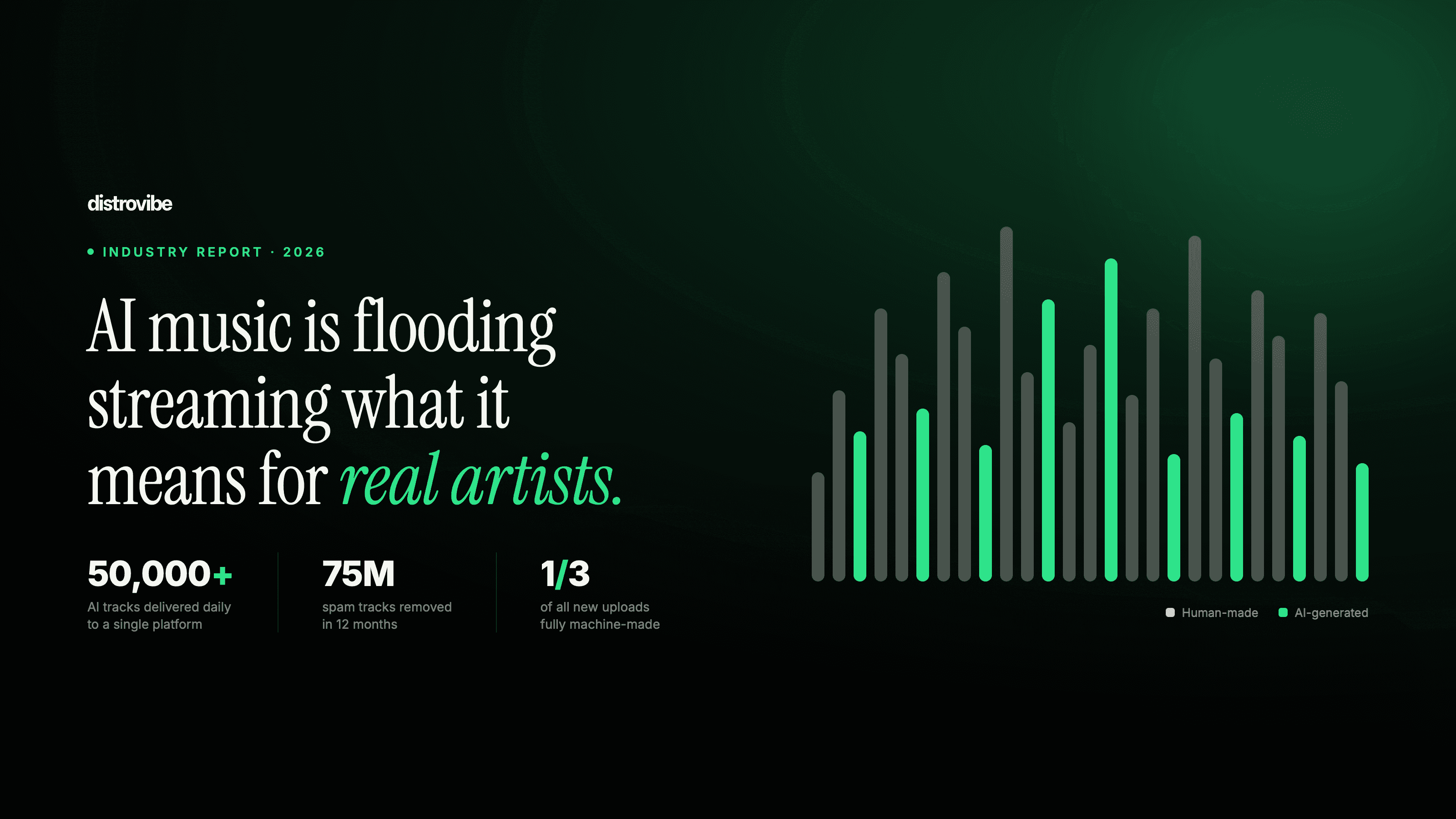
Something unprecedented is happening in music streaming right now. Deezer reported that by late 2025 it was receiving over 50,000 fully AI-generated tracks each day roughly one-third of all new deliveries to the platform. Let that sink in: one out of every three tracks arriving at a major DSP is now made entirely by a machine.
The platforms are responding aggressively. Spotify removed more than 75 million spam and low-quality tracks over a 12-month period as it strengthened protections against fraudulent and AI-related uploads. Bandcamp went even further as of January 2026, it has banned fully AI-generated music uploads and the use of AI to imitate other artists entirely
If you're an independent artist making real music, this is the single most important industry shift to understand this year. It affects how your uploads are reviewed, how your royalties are calculated, and how listeners perceive everything they hear. Let's break it down.
Why AI Tracks Are Flooding the Platforms
The obvious question: who is uploading 50,000 AI tracks a day, and why?
The uncomfortable answer is that most of it isn't art it's arbitrage. Data from Deezer suggests that far more of these tracks are being generated for fraud than because fans actually want to hear them.
The scheme works like this: bad actors use generative AI tools to mass-produce thousands of tracks at near-zero cost, upload them through low-barrier distributors, and then use bot farms or stream manipulation services to generate plays. Because streaming platforms operate on a pro-rata royalty pool, every fraudulent stream siphons money away from legitimate artists.
In other words: AI slop isn't just cluttering the catalog it's literally taking money out of your royalty check.
This is why the platform response has been so severe, and why it's only going to intensify.
How the DSPs Are Fighting Back
Each major platform is taking a different approach, and understanding these differences matters for anyone releasing music in 2026.
Spotify: mass removal and stricter upload scrutiny. The 75-million-track purge was just the visible part. Behind the scenes, Spotify has tightened fraud detection on artificial streaming, cracked down on duplicate and manipulated uploads, and increased penalties passed down through distributors. Artists whose catalogs get flagged even mistakenly can face payout freezes and takedowns.
Deezer: detection and transparency. Deezer has positioned itself as the industry's data leader on this issue, publicly reporting AI upload volumes and developing detection systems that tag fully AI-generated content. Its philosophy is less about banning AI outright and more about labeling it and excluding fraudulent content from royalty pools.
Bandcamp: a hard line. Bandcamp's January 2026 policy bans AI-generated music uploads outright, though hybrid productions where a human artist uses AI as a documented tool remain allowed if credits are transparent. For a platform built around direct fan-to-artist relationships, this is a brand statement as much as a policy.
The legal layer. The legal framework for AI-generated music is still being defined, with the US Copyright Office ruling that fully AI-generated works cannot receive copyright protection. That's a crucial detail: a track made entirely by AI has no copyright owner, which means no enforceable master rights and no long-term catalog value.
What This Means for Real, Human Artists
Here's the counterintuitive good news: the AI flood may actually be making human artistry more valuable, not less.
While AI can generate music that mimics moods and feelings, there's still something intangible about human-crafted emotion that listeners recognize and fans are gravitating toward songs and artists that convey authenticity. In a sea of algorithmically generated background noise, a real artist with a real story stands out more than ever.
But there are practical consequences you need to manage:
1. Upload scrutiny is higher for everyone
Fraud detection systems don't just catch fraudsters they generate false positives. Distributors that flood DSPs with unvetted content put their entire artist rosters at risk, because platforms increasingly penalize at the distributor level, not just the track level. Choosing a distributor with real content review and fraud prevention is no longer a nice-to-have; it's protection for your catalog.
2. Never, ever buy streams
If the temptation to use a "playlist promotion" service that guarantees stream counts was ever there, 2026 is the year to bury it. Detection systems have become dramatically more sophisticated, and the penalties royalty withholding, takedowns, account termination are being enforced more aggressively than at any point in streaming history. Artificial streams on your track can get your entire release removed, even if a third party generated them without your knowledge. Only work with promotion partners who are transparent about their methods.
3. Metadata and credits matter more than ever
With platforms scanning for duplicated content, soundalike fraud, and impersonation, clean metadata is your defense. Accurate songwriter credits, correct ISRC codes, consistent artist naming across releases these signals tell DSPs your content is legitimate. Sloppy metadata increasingly looks like a red flag.
4. Disclose AI use honestly
Using AI tools in your workflow for mastering assistance, stem separation, or idea generation is normal and widely accepted. AI has moved from novelty to standard infrastructure across the industry. But hiding fully AI-generated vocals or compositions behind a human artist name is exactly the behavior platforms are hunting for. Industry professionals and platforms that are transparent about what AI does and does not do will build more trust than those that obscure it.
The Bigger Picture: A Maturing, More Selective Market
The AI flood is arriving at a moment when streaming economics were already tightening. Streaming is no longer growing at 20%+ annually in major markets, and the number of tracks uploaded to streaming platforms continues to grow faster than listening hours. More music is competing for the same amount of listener attention and AI-generated content is accelerating that imbalance dramatically.
This is pushing the industry toward quality filtering at every level. New platforms like Vocana are emerging that focus exclusively on indie artists, emphasize user-driven discovery over algorithms, and employ user-centric royalty models that reward artists with devoted fans. The direction of travel is clear: away from "upload anything, algorithm sorts it out" and toward curation, verification, and direct artist-fan relationships.
For independent artists, the strategic implication is significant. Streaming alone is an increasingly difficult path to meaningful income, and diversification into live performance, merch, sync, and direct-to-fan revenue is no longer optional for sustainability. Your streaming presence remains essential infrastructure but it works best as the discovery layer of a broader career, not the entire business model.
How to Protect Your Music and Royalties: A 2026 Checklist
✅ Distribute through a platform that vets its catalog. Distributors with fraud detection and content review protect you twice: your uploads clear DSP scrutiny faster, and your royalties aren't diluted or endangered by fraudulent content sharing your distribution pipeline.
✅ Keep your rights documentation airtight. Master ownership, split sheets, songwriter registrations. In an era where copyright status determines whether content can even be protected, paperwork is power.
✅ Register with a PRO. With royalty pools under pressure from fraud, collecting every legitimate royalty stream you're owed performance, mechanical, neighboring rights matters more than ever.
✅ Build direct fan relationships. Email lists, community platforms, direct-to-fan sales. Fans you can reach directly are fraud-proof, algorithm-proof, and platform-proof.
✅ Be transparent about your process. If AI plays a role in your production workflow, document and disclose it appropriately. Authenticity is becoming the scarcest asset in music.
Where Distrovibe Stands
At Distrovibe, we built our platform around a principle that suddenly looks prophetic: curation and fraud prevention protect artists.
Every release distributed through Distrovibe passes content review before delivery. We monitor for artificial streaming patterns, maintain clean metadata standards, and operate a curated artist community rather than an open floodgate. That means your music enters DSPs with credibility and your royalties aren't sitting in the same pipeline as mass-generated fraud content.
The AI flood is real, and it's reshaping streaming faster than any trend in a decade. But for genuine artists with a real distribution partner, it's not a threat it's a filter. And filters favor the real.
Ready to release your music through a platform that has your back? Distribute with Distrovibe →